Saturday, March 7, 2026

Questions

Why does...?
           Because...

Who will...?
          I think...

When did...?
          Let's ask...

Where are...?
          We can look...

What is...?
          As far as I know...

Do you...?
          Sometimes.

Can I...?
          Yes.

Treasure your child's questions and offer loving answers.
Relationships are built of these things.

SandraDodd.com/conversation
photo by Zann Carter

Friday, March 6, 2026

Word tree


SandraDodd.com/words
Image by an engineering student in the UK whose Fiverr name was Spartali, in 2014

Thursday, March 5, 2026

A bigger big world

It is strangely possible to learn from the whole wide world without participating in its pervasive school aspects. It's a little like polarized glass—where you change the angle a little and it all looks CLEAR!! Tilt it back and it all looks dark.

It's a big world and school does not own it.

And the big world is not just right now, as is. It's all its history, all its future, all its imaginings and myths and fantasies and alternate endings. School presents a little package of one version of history, a little package of one summary of science, etc., and leaves all else out.

the whole wide world and what schooling isn't
photo by Sobia Itwaru

Wednesday, March 4, 2026

Choosing food

The idea that one can learn to feel and know one's own body and choose foods accordingly is shocking to most people. I wouldn't have thought it sensible or possible, when I was younger, but having given my three children the option to turn down any food, and to try any food, to choose their own quantities of food has shown me a whole different aspect of human learning and instinct.

It should make sense. Early people wouldn't have continued to eat what wasn't good for them if they weren't starving. If they had options, they would have chosen the things that seemed (for whatever range of reasons they might be choosing) good. There are food taboos and preferences all over the world. Some are credited to religion or superstition. Some are medicinal. All were, originally, local.

In a situation in which there is an abundance of food shipped and traded all over the world, then how does one choose? This is what is coming to be called "a first-world problem." In terms of learning, though, in the context of the life of a family choosing unschooling and mindful parenting, the question is answered every time food is bought, presented, consumed or considered.

SandraDodd.com/eating/choices
photo by Sandra Dodd

Tuesday, March 3, 2026

That was all!?

AJ wrote:

I'm amazed at how easily some things are learned. My five year old is learning to read. He was playing a computer game that had him putting together words to make compound words (sand + box gives you sandbox, etc.). He wasn't sure of a word, so I told him what it was and explained about how words ending in "e" work. Pointed out one or two more examples as they came out and presto! He understands Silent E.

Then I stood there not sure what to do. That's it? That was all it took to learn about Silent E?? But, but...it was a huge deal when I learned to read in school! There were many lessons. Drills. That song on the Electric Company. How could all of that fuss have been needed for something that took Mikey about 30 seconds to grasp? Ah, the wonders of learning something when you are ready and not before!
—aj (mamaaj2000)

SandraDodd.com/learning

"that song on the Electric Company"
photo by Karen James

Monday, March 2, 2026

Be glad

Live in the moment as well as you can and be glad of happy surprises.


Surprises

Living in moments
photo by Andrea Taylor

Sunday, March 1, 2026

Let go!

Joyce wrote:

Formal learning is being certain you can't let go of the side of the pool. Unschooling is paddling around in the deep end.
—Joyce Fetteroll

SandraDodd.com/nutshells
photo by Cátia Maciel

Saturday, February 28, 2026

Slipping through the cracks?

Lyle Perry wrote:

Deschooling is all about letting go. Letting go of your schoolish ideals, and even more important than that (in my opinion) is letting go of your expectations for your kids. When you expect something, it's so easy to set those expectations too high, and that can lead to feelings of failure, for both you and your child. No two kids are alike, and they should not be treated as though they are just another face in the crowd, and that is what happens in school.

There is no one-size-fits-all educational system that works, contrary to what any public school advocate will tell you. How many times have you heard about children "slipping through the cracks" at public school?

With unschooling, no child slips through the cracks, because the cracks don't exist.
—Lyle Perry

SandraDodd.com/lists/lyle
photo by Janine Davies

Friday, February 27, 2026

Values


"Meredith Meredith" wrote:

If you value something, make it part of your life. If you value music, play music, listen to music, dance and sing. Invite the people you love to join you—maybe they will. If you value scientific thinking, think like a scientist. If you enjoy math, play with numbers and relationships. The catch is to live your own values without trying to foist them off on other people—because that's not a very good way of sharing what you love, and because personality matters. All your singing and dancing won't make your kids musicians if they're not so inclined—but they'll know a few things about music. If you push music at them, they may associate what they know with drudgery and unhappiness—and then you've failed and failed more utterly than if you never sang a note in their presence.
—Meredith Novak

Meredith
photo by Sandra Dodd, of Marty kid-art

Thursday, February 26, 2026

See your child

Seeing a child where he is, and as he is, leads to love.

Seeing a child in comparison to an ideal, imaginary child can lead to heartbreak all the way around.

SandraDodd.com/look
photo by Tara Joe Farrell

Wednesday, February 25, 2026

Learn and be an example

Colleen Prieto wrote:

Realize your unschooling life and someone else’s unschooling life won’t look exactly just the same, and that’s because your kids and their kids, your partner and their partner, your house and their house, your interests and their interests… they’re not the same either. But still read, talk, and think about what you are doing, and listen to what others are doing. Learn from the example of people who have been there/done that, and be an example for those who will come after you on the unschooling path.
—Colleen Prieto

From Colleen's writings at the bottom here: SandraDodd.com/video/doright
photo by Sandra Dodd

Tuesday, February 24, 2026

Joyous but careful

How we use words with our children affects their future and our present, so be joyous but careful with your parenting word-power!

SandraDodd.com/words/
photo by Megan Valnes

Monday, February 23, 2026

Seeing what learning is

When a newcomer was very confused, Meredith Novak wrote:

The basis of unschooling comes from seeing learning as a substantial human drive and seeing that learning depends absolutely on the perceptions of the learner. The second part is what makes everything tricky - you can't control what someone else learns. At best you can work on seeing the world from another person's perspective and try to create an environment which helps that person learn.

It can help a lot to think about how people learn via their hobbies. In a way, that's what real life unschooling looks like: people learning through hobbies. It usually involves a lot of playing around - and the playing around parts are just as important to learning as the parts where you need to go look something up, or network with another hobbyist, or take a class or workshop to improve a skill.

One of the common parenting/educational myths is that it's possible to imbue children with "good habits" by making them do certain things over and over. It Seems like it Should work... but when you look at adults there's no evidence it does. The results are pretty random. It's not a strategy that helps people learn about the world.
—Meredith Meredith
July 2012

SandraDodd.com/meredithnovak
photo by Carolyn Vandenbusch Neves

Sunday, February 22, 2026

Overflow is good

Having a happy home comes from the creation and maintenance of happy conditions! Produce as much as you can. You'll fill yourself up and it will overflow, and your family might even have enough to share with friends and strangers!

SandraDodd.com/cup
photo by Janine Davies

Saturday, February 21, 2026

Brain food


Pam Sorooshian wrote:

Human brains are voracious and will feed on whatever is available. Unschoolers should be offering interesting experiences, ideas, stimulation, music, logic, conversation, images, movement, discovery, beauty, etc. Brain food in abundance. It requires effort. It requires attention to qualitative and quantitative aspects of learning. Depth and breadth—creating a lifestyle in which kids are offered the opportunity to learn a lot about some things and a little about a lot of things.
—Pam Sorooshian


SandraDodd.com/learning
Thanks to Marta Venturini Machado for finding and sharing that quote.
photo by Meghan Pawlowski

Friday, February 20, 2026

Like nothing else


If a parent can learn how to "facilitate learning"—to help a child get what he needs or wants—rather than to direct or try to own it, all of unschooling goes better. And if a child learns to read without "reading instruction," that can open the world up like nothing else can.

SandraDodd.com/r/deeper
photo by Alicia Gonzalez-Lopez

Thursday, February 19, 2026

Being mindful

Try to be a good unschooling parent, a generous freedom-nurturing parent, a parent providing a peaceful nest, a parent wanting to be each child's partner. Try to make your decisions in that light.

SandraDodd.com/mindfulness
The text above paraphrases something I wrote there.
photo by Brigita Usman (click to enlarge)

Wednesday, February 18, 2026

Variable, thoughtful lunch


Some days lunch is medicinal—one child is sickly and could use soup or juice. One is off to a sports event, and carbohydrates are a good idea. One is sad, and would like comfort food. One is bored, and her sandwich could use a face.

Be as loose as a dancer, as variable as an actor, as thoughtful as a chessplayer, when you decide what to make for lunch sometimes!

SandraDodd.com/eating/peace
photo by Hinano

The words are from Little meals make big memories

Tuesday, February 17, 2026

Clarity and Focus

Clarity and focus make things easier.

Muddly confusion make things harder.

SandraDodd.com/clarity
photo by Janine Davies

Monday, February 16, 2026

Living lightly

John Quincy Adams is credited with having said, “If your actions inspire others to dream more, learn more, do more and become more, you are a leader.”
The sentence above came from a post by an unschooling dad, Sean Heritage. In the post he's talking about his unusual approach to his job as a Commander in the U.S. Navy. Some of his ideas might have been inspired by his unschooling experiences, but Sean's ability to see in the way he does must surely be making unschooling easier at his house.

In your family, in your unschooling, in each dyad/partnership within your family, if you inspire dreaming, learning, doing and becoming, you'll be leading in an exceptional way.

Sean Heritage is retired now; the post originally appeared in 2015.
His writing from which I pulled the quote: Unicorns and Fairies

Being your Child's Partner is probably the best match on my site.
photo by Megan Valnes

Sunday, February 15, 2026

Meeting needs

After physiological needs, Maslow says people need to feel safe and secure. Next comes the set of belonging, affection, and positive regard.

The application to unschooling is that if the child isn't hungry, tired, afraid or feeling unloved, there should be no problem with curiosity and the desire to experience other things.

SandraDodd.com/maslow
photo by Roya Dedeaux

Saturday, February 14, 2026

From Dictator to Partner

Kelly Lovejoy wrote, in "Wet Paint":

I could have easily have remained a dictator had I not found unschooling and mindful parenting. I like when folks do what I say! Cameron has always been very compliant, so being a benevolent dictator was easy. Duncan, on the other hand, questions everything! I needed to change how I approached parenting with him—and that’s helped in my dealings with Cameron too. Stepping back and realizing that obeying orders was not in my children’s best interest was huge to me.

It’s helped me to change my language a bit. Rather than say, "Don’t touch the bench: the paint is wet," I'll now say, ”That paint may be wet. You might want to be careful if you touch it.” That gives them information to think through instead of an order to follow or disregard. They might ask how I know it’s wet. Or did I see a painter leave? Is there a sign? How can we tell when it’s dry? What does 'tacky' mean?

And they might go ahead and touch it. But that gives them the information they need. And that’s OK. One more brick in your tower.
—Kelly Lovejoy

SandraDodd.com/kellylovejoy/wetpaint
photo by Sandra Dodd

Friday, February 13, 2026

Already full

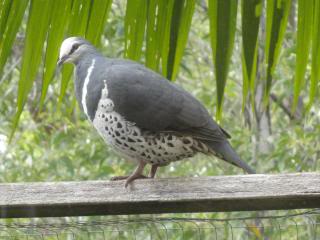
fat spotty wonga pigeon on a fence with tree fronds behind

"I don't need to stuff him full of who I need him to be, because he's already full of who he is."

—Schuyler Waynforth
March 29, 2014
Gold Coast symposium

SandraDodd.com/understanding
photo by Sandra Dodd of a wonga pigeon at Schuyler's
(The quote is about her son, not about a pigeon.)

Thursday, February 12, 2026

Lasting happiness

"Fun is serious. Fun is important, especially for kids. Don't underrate fun. People who are not happy as children seldom find easy or lasting happiness as adults."
—Deb Lewis
SandraDodd.com/t/cartoons
photo by Susan Burke

Wednesday, February 11, 2026

Learning for fun

The separation of learning and fun is the only thing that keeps learning from BEING fun.

Perhaps this will be seen as preaching to the choir, but I prefer to think of it as teaching a new song to an experienced, enthusiastic choir.


Learning is fun.

Playing with ideas is fun.

Living becomes learning
photo by Karen James

Tuesday, February 10, 2026

Stop, breathe, and change


Caren Knox wrote:

Trust is a vital foundation to building an unschooling home. If kids can't trust that what their parents are saying is true, their foundation is shaky, perilous. That affects their ability to learn, and harms the relationship they have with the world (and their parents).

Why bring a negative force into the home?

If you're used to sarcasm and other lying, it might take practice to learn to speak honestly. It can feel vulnerable and risky. It is worth it. You'll soon be able to feel if what you are about to say is true — really true — and you'll develop the ability to stop, breathe, and change what you're saying if needed.
—Caren Knox


Deposit the good stuff.
photo by Cathy Koetsier

Monday, February 9, 2026

Better, without regrets


Do your best to do your best.

You won't regret making more positive choices.


SandraDodd.com/better on my site
and
"Better" on Just Add Light and Stir
photo by Renee Cabatic

Sunday, February 8, 2026

Partnership, joy and fun

Chris Ester wrote:

What bothers me most... (about a questionable definition of unschooling) is that it is all about the parent and their level of comfort. Focusing on what the parent can 'bear' at the possible expense of the child irks me....

Thank you Sandra, et al. for the clarity that you provide. The talk of partnership and joy and fun with clearly stated principles in mind is challenging to the status quo and stretches many of us, but it is certainly much more helpful.
—Chris Ester


Appropriating the word Unschooling
photo by Sandra Dodd
(a tied game against Keith;
newer than the writing)

Saturday, February 7, 2026

The panoply of wonder

Robyn Coburn, when Jayn was little:

Jayn certainly finds learning inescapable. Educational is an irrelevant label to her, neither endorsed nor discarded. Her first issue continues to be whether the item looks like fun or is simply beautiful enough to warrant a place in the panoply of wonder that already inhabits her imagination.

Truly I believe that her greatest cognitive leaps have come from the most frivolous seeming of her pursuits. Her most profound discoveries have come from her interactions with the least overtly educational of her tools&mddash;her play toys and her animated movies. It is not work masquerading as play to make it palatable; it truly is that all her most valuable work is play.
—Robyn Coburn

SandraDodd.com/robyn/label
photo by Robyn Coburn

Friday, February 6, 2026

One thing leads to something else


Mary Ellen (nellebelle) wrote, years ago:


Up to now, we have never had any video games in our house. It wasn't that I purposely avoided them, it was just something we'd never done and the girls had never asked for. I had a vague idea in my head that they were negative along the lines of TV and other electronic media. Generally, when video games make the news it is not positive. I had never before questioned these ideas. Lisa had mentioned playing a race car game at her friend's house. We decided to give the girls a Nintendo64 for Christmas. This morning I played Crusin World with Lisa. The game is full of famous landmarks. It is not totally realistic, but does match many real aspects of the countries you race through. While cruising Germany, I mentioned the autobahn. I don't know too much about it, except that people drive really fast there. This led us to consider mph vs. kph, which led to the metric vs. US system of measurement. I told Lisa that I had bought some stuff to help learn the metric system because I wanted to understand it better. She said, "We can learn it together".

It never ceases to amaze me how doing one thing can lead to learning about something else.
—Mary Ellen(nellebelle)

"Everything I really need to know I learned from video games and cheesy cartoons."
SandraDodd.com/t/cheesy

image respectfully lifted from
Launchbox Games Database

Thursday, February 5, 2026

Learn and share

Karen James, to a worried mom with a young teen daughter:

Try not to worry. I know that's hard. I'm a worrier, myself. But when we worry about another person, it becomes a burden for them on top of what they are already experiencing. Just be with her, as fully as you can. If she's telling you she's bored, she's inviting you into her experience. Join her. Learn about her. Share yourself with her too. You'll likely learn a lot about her (and yourself) in the process, and I'm confident it will be enriching and rewarding for you both.
—Karen James

A gentle approach to boredom
SandraDodd.com/boredom/karen

photo by Sandra Dodd

Wednesday, February 4, 2026

Random words, or CHOSEN words?

In an unschooling discussion, once, someone commented just this:
Evidently this is a place to choose one's words extremely carefully.
I responded:
YES!!
Yes, it is.
This group is a place to choose one's words carefully.

One wonderful thing about that is that if one practices that here, and sees the value in it, maybe she will begin to choose her words more carefully when speaking to her children, or her partner. Her other friends and relatives probably wouldn't mind if she chose her words carefully when speaking to them.

And in other groups, too—a humor group, or Korean drama group, Viking crafts group, puppy-training group—wouldn't it be best to choose one's words carefully?

SandraDodd.com/mindfulofwords
photo by Sandra Dodd

Tuesday, February 3, 2026

Kids first, positively

In a social group, if a mom gets comfortable, she can spend years just chatting with those other moms without paying much attention to her own children other than keeping them fed, clothed and safe. If they're in school, that's not so bad.

If they're unschooled, though, the bulk of her time and energy should be with, on, about THEM, and the family, and the relationships. Unschooling should be better than school; if it's not, the kids would be better off in school.

Any unschooler who wants to do just the bare minimum of what she "has to do" to be considered (by whom!?) an unschooler is NOT unschooling well or right. It needs energy, activity, interactivity, flow, sparkle, joy.

People who come [to a discussion group] with ANY amount of Eeyore attitude, and those who defend that, are dragging people under and I don't want to condone that or provide a forum for anyone to drag potentially joyful people into a hole, justifying complaints, collecting negativity.


Please don't try to turn your unschooling into social groups. Don't look for "a tribe." Don't put your loyalty toward an unschooling group, or a conference. When that group becomes complacent, or negative, then you will, too.

Find a way to unschool confidently, even if all your other friends buy a curriculum or put their kids in school.

SandraDodd.com/positivity
photo by Annie Regan

(source, on facebook)

Monday, February 2, 2026

Demons (avoidance of)

If a family thinks that "having no junk food" in the house will ensure a child's health for eight or nine decades, they are incorrect in that belief. If the mother thinks that it will absolve her of any blame in future dietary choices, she is also incorrect.

Demonizing food creates a demon. Being calm creates more calm.

SandraDodd.com/control
photo by Sandra Dodd

Sunday, February 1, 2026

Other things flow


Being a child's partner rather than his adversary makes the balance of knowledge unimportant. Nowadays my children drive me around, help me out, read small print and get things off high shelves. For many years, I did those things for them.

SandraDodd.com/partners

SandraDodd.com/balance

Learning first, and partnership and being present close after, and all the other things flow in around it.


Part of a longer response to an odd question: The other things flow in around it.

See also "Snapshot" on this blog
photo by Karen James

Saturday, January 31, 2026

Bright and shiny things

Schuyler Waynforth wrote:

Often if I'm stuck not being able to see the positive in something, I need to quit looking at it. I need to look at other things. I need to find something to move forward to instead of whirling and twirling around the angsty thing. Make the angry thing small and insignificant, turn away from it, look for bright and shiny things to distract you, look at tiny things that give you pleasure, look at large things that you didn't appreciate fully the first time around. Turning toward joy will definitely make it harder to feel stymied in the negative.
—Schuyler Waynforth

SandraDodd.com/distraction
photo by Vlad Gurdiga

Friday, January 30, 2026

Distraction can be a blessing

If someone is flipping out, distraction can be a blessing. If the problem is insurmountable, they will get right back to it. If the problem was that the problem itself was creating feedback and a small thing had turned into a roar, distraction can break the tension and let them breathe and relax, or even better—to laugh and to slump until some adrenaline can pass.

The reason I'm telling this sudden story is that in another topic Meredith wrote:
I've been listening to a podcast called The Hilarious World of Depression which is all interviews with comics who have various kinds of depression. In one episode (I don't recall which) they talk about distraction, and how it's actually a helpful strategy for a lot of people with anxiety, depression, and the like. That was nice to hear. There's a lot of pressure on people to journal and talk and ruminate and Not try to be distracted, but it turns out for some people distraction is a good thing.

SandraDodd.com/distraction
photo by Jo Isaac

Thursday, January 29, 2026

Kindness, grace and generosity

Meredith wrote:

Expecting human relationships—of any kind—to be fair and equitable is a set-up for cynicism and disappointment in the human race. Human beings are marvelously varied in their needs and capabilities. It helps a whole lot to think in terms of needs and capabilities rather than rights or fairness or equality. What more can you do to support the people you love—including yourself? Kindness, grace, and generosity go a lot further toward creating warm relationships and a joyfully harmonious home than measuring out equality.
SandraDodd.com/50/50
photo by Cátia Maciel