Showing posts sorted by date for query math playing. Sort by relevance Show all posts

Sunday, June 7, 2026

Math from My Little Pony

Dr. Christine Alvarado, a science professor at UC San Diego, on how playing with My Little Ponies moved her toward math and engineering:
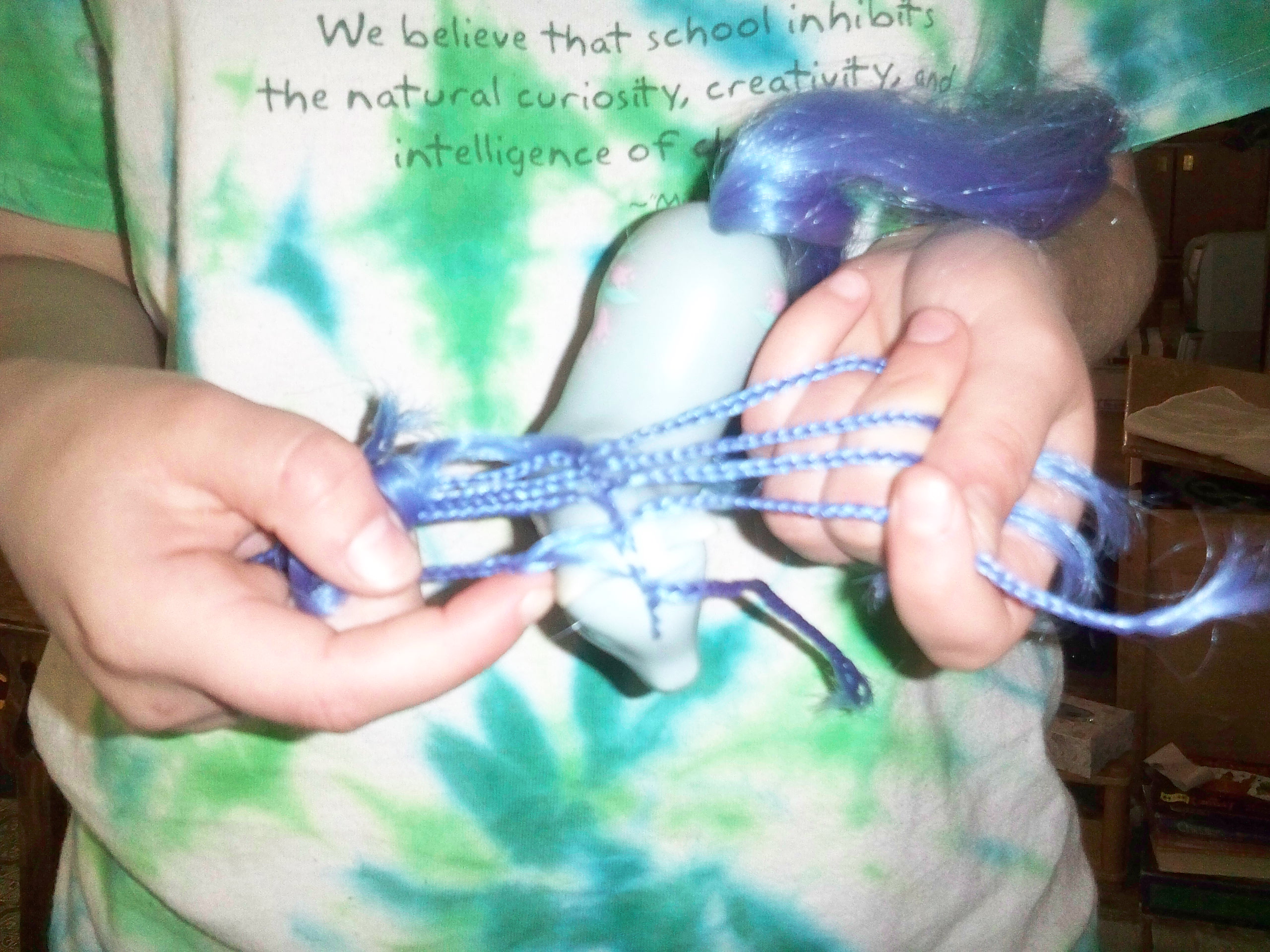
When I started, I took the hair on the Pony's tail and divided it into three pieces for braiding. Soon I became bored with a single braid. I then divided the tail into nine pieces and made three groups. I braided each group of three until I had three braids, then took these three braids and braided them together.

Soon I was up to starting with twenty-seven pieces (nested down to nine braids, then to three and then one) and then on to eighty-one. All the while I was learning about math: I saw that division is the process of taking a large number of things and grouping them into a smaller number of groups. In order to end up with one even braid at the end, I had to be able to divide the initial number evenly by three, then by three, and then by three again, until I ended up with just one braid.
The day after that page was made, I took a photo of some of my daughter's ponies, to use as an illustration at an announcement post, Sleep, Teens, My Little Pony & Science.

Holly, 18, had been away from the house. She came in and saw the ponies out, so I showed her the photo and read her a bit of the Christine Alvarado article. Holly got another pony to show me, told me about the plan of the braids and the angles to get them to cross and stay crossed, and what could be done with those braids, but that she usually twists them into a bun, and had left some unbraided hair out at the bottom of the mane to fasten that bun up with.
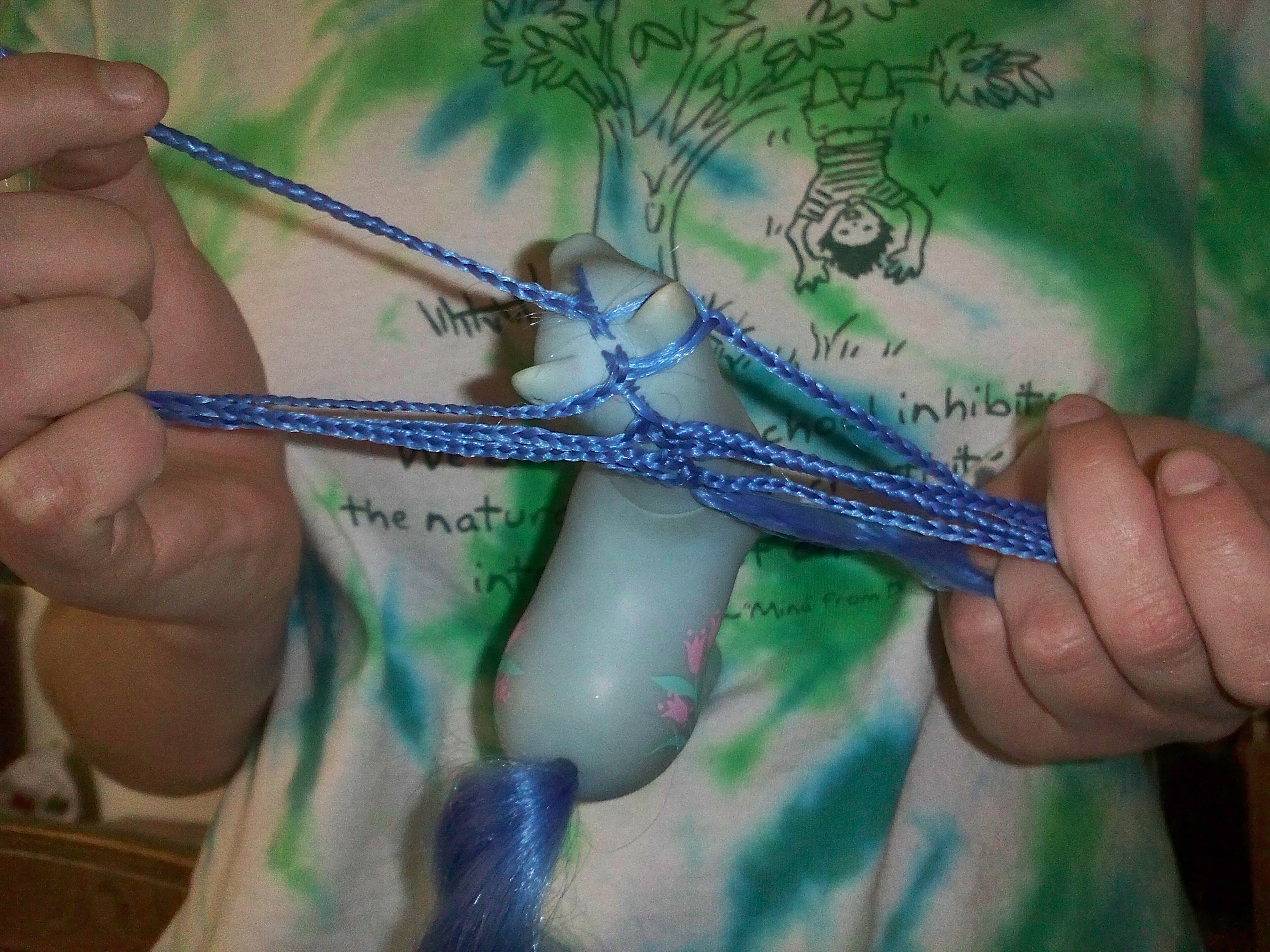
I couldn't even keep up with the explanation. Just sayin'... 🙂

There's more of what Christine Alvarado wrote here:
SandraDodd.com/mylittlepony
photos by Sandra Dodd, but Holly did all the braiding

Thursday, May 7, 2026

A puzzle to play with

Linda Wyatt wrote:

Algebra is the art of taking the information you have, the things you know, and using that to figure out the information you don't have, that you need to know. It's a puzzle. That's all. You "expose" kids to it by doing it, by playing with it freely and uninhibitedly. By finding things fascinating and wanting to figure out what you don't know. By experimenting. By needing it.
—Linda Wyatt

SandraDodd.com/math/
photo by Shonna Morgan

Saturday, August 30, 2025

"I told him already."

Not lately, but once upon a time...

...When the triangles come up on Math Arena, I have to think "isosceles" and then look for one (or "right" or "equilateral" or "obtuse" or whatever). Holly doesn't have to.

So my strewing plan was this: The next morning I would wake up early, make tea, and get out the geoboards. We have three. I would set up three basic triangles. When Holly got up and noticed these out, I would point at the hypotenuse on the right triangle. Either she would say "huh!" and "Would you make Malt-o-Meal?" and it would be over, or she might ask "And what are these other two?" Maybe it would be a couple of days of playing with triangles and maybe it will be one little "huh!"

That was my whole plan. I was going to be fine with however minor or glorious it was, because I knew she would have something to tie it to in her head, another dot to connect, and all that internal triangulation would be more valuable than any vocabulary study and formulaic recitation we could do.

But what happened was that I forgot to check back on my geo-board kid-trap. When I remembered in the early afternoon, Marty and Holly were working on fancy designs with colored rubber bands, and making "how many triangles?" puzzles for each other to count triangles within triangles. I came over and said, "That is a hypotenuse," and I pointed right at a green rubber hypotenuse. Holly said, "I know, I told him already." Not only had I missed my big chance to review it with her, she (at twelve) had already explained it to her brother (the fifteen year old).

SandraDodd.com/dot/hypotenuse
photo by Julie Daniel, of Adam, also not recent
(I couldn't find a geoboard photo)

Sunday, December 8, 2024

Odd combos


The connection between humor and learning is well known. Unexpected juxtaposition is the basis of a lot of humor, and even more learning.

It can be physical, musical, verbal, mathematical, but basically what it means is that unexpected combinations or outcomes can be funny. There are funny chemistry experiments, plays on words, math tricks, embarrassingly amusing stories from history, and there are parodies of famous pieces or styles of art and music.

SandraDodd.com/playing
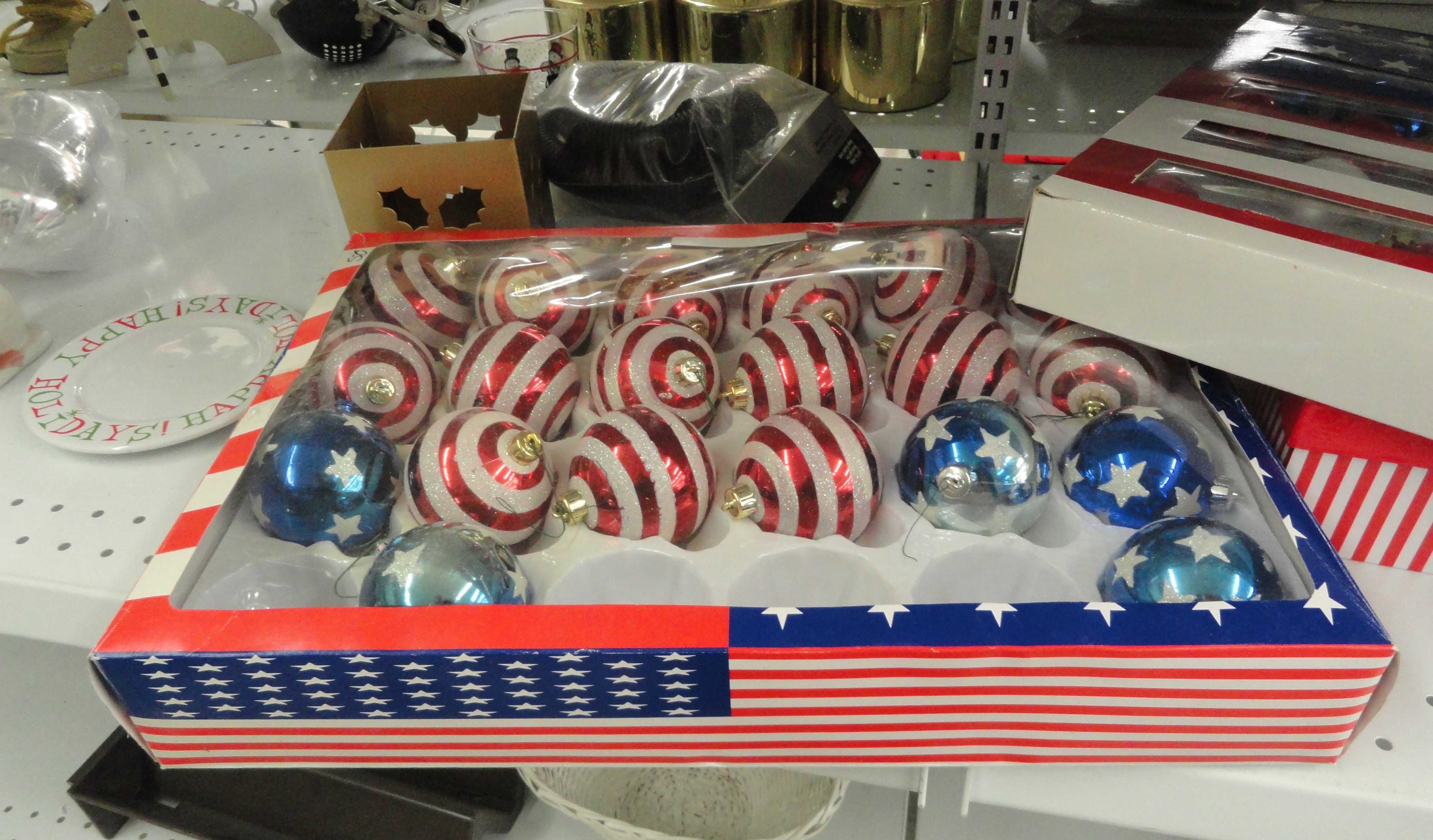
photo by Sandra Dodd, one day at Goodwill

Saturday, August 31, 2024

Determination, focus and interest

Hema Bharadwaj wrote:

I can't begin to say everything I feel about video games... from my beginning ambivalence / aversion / annoyance / fear / more fear, etc. all the way to today's complete acceptance of my child's love and devotion to figuring out a game, his determination, his focus, his interest, his ability to explain it, talk about it passionately, willingness to give Ravi and me tutorials/workshops on a game etc.

He is currently playing a game that is about a guy in school. And the classes need you to figure out games/words/math etc. Then you pass the game. I help him out with certain parts when he asks for it. Been very interesting to watch his intensity in figuring out those puzzles/tests that the school teachers are throwing out to this character. The character gets bullied and keeps getting detention. And Raghu is wondering why this is so. Leads to conversations about the way the video gamer designed the game.
—Hema Bharadwaj
2010

SandraDodd.com/game/benefits
photo by Penny Clarkson

Monday, September 19, 2022

Amazement


Julie:
Love this! Years later I'm learning about things I thought I hated (science & math come to mind immediately) alongside my kids while laughing, playing and being amazed. 🙂

Sandra:
The amazement is the magical-transformation stuff! 🙂


The quotes above are from comments on this post: Happy Choices
SandraDodd.com/wonder
photo by Eleanor Chong

Tuesday, February 12, 2019

How will their learning be used?

Pam Sorooshian wrote this:

The time spent mothering and playing is not time away from real learning—not to be rushed through to get to "the good stuff" as some may think of it. It is essential to real learning and, really, to allowing the child to grow up as a whole, integrated human being.

Homeschoolers think a lot about learning—but they often focus on learning to read, write, do math, or learning science or history, etc. Unschoolers tend to take that kind of learning for granted, it happens along the way. Instead, as we get more and more into unschooling, we tend to focus on things like kindness and creativity and honesty—all those character traits that will determine "how" their learning will be used in their lives.
—Pam Sorooshian


SandraDodd.com/nest
photo by Sandra Dodd

Tuesday, February 9, 2016

Humor and learning

dirt, rocks and three tiny cactus in a clear coffee cup
The connection between humor and learning is well known. Unexpected juxtaposition is the basis of a lot of humor, and even more learning. It can be physical, musical, verbal, mathematical, but basically what it means is that unexpected combinations or outcomes can be funny. There are funny chemistry experiments, plays on words, math tricks, embarrassingly amusing stories from history, and there are parodies of famous pieces or styles of art and music.

SandraDodd.com/playing
photo by Becky Sekeres

Friday, September 4, 2015

Happily, with a purpose

Once when a new video game was to come out in three weeks or so, I overheard Marty and Kirby discussing at length and without any frustration all the different combinations of ownership and funding might be possible for them to put their allowance together and buy it. If Kirby contributed as much as Marty's allowance, they could be co-owners, but wouldn't have enough to get it the day it was released. Could Marty owe Kirby, and buy in up to 50% later? Should Marty just own a lesser percentage? I think they were 9 and 12 or so. It was complicated math, with all those percentages of increments of age times .75, but they were doing it, and just in their heads, and happily, with a purpose.

They didn't think to ask us for help. They didn't feel they needed to.


SandraDodd.com/money
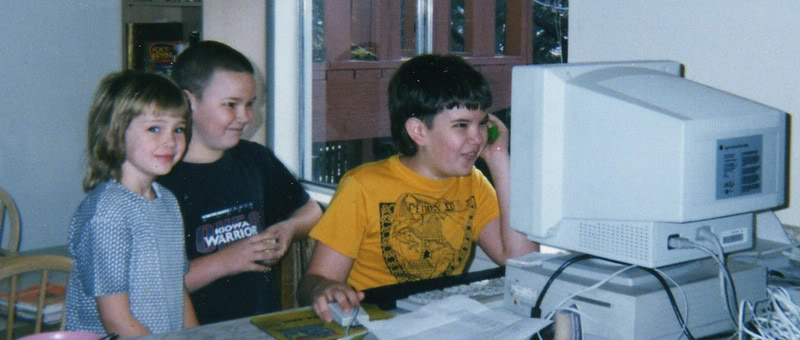
photo by Sandra Dodd, of my kids playing Zoombinis,
not a Nintendo or Playstation game,
but their ages match the story above.


NOTE: I hope your family can afford more, but our kids got seventy-five cents per year of age, weekly. So in the example above, if they were 9 and 12, Marty was getting $6.75 and Kirby was getting $9.00. Console games were $50 or $60 in those days.

Friday, September 26, 2014

Unexpected juxtaposition

The connection between humor and learning is well known. Unexpected juxtaposition is the basis of a lot of humor, and even more learning. It can be physical, musical, verbal, mathematical, but basically what it means is that unexpected combinations or outcomes can be funny. There are funny chemistry experiments, plays on words, math tricks, embarrassingly amusing stories from history, and there are parodies of famous pieces or styles of art and music.


SandraDodd.com/playing

La connexion entre l’humour et l’apprentissage est bien connue. Des juxtapositions inattendues sont la base d’un certain humour, et encore plus, de l’apprentissage. Cela peut être physique, musical, verbal, mathématique, mais au fond, ce que cela signifie, c’est que les combinaisons ou les résultats inattendus peuvent être amusants. Il y a des expériences chimiques amusantes, des jeux de mots, des jeux de maths, des textes historiques amusants et embarrassants, et il y a des parodies de pièces célèbres ou de styles artistiques et de musique.

SandraDodd.com/french/playing
photo by Sandra Dodd, of artsiness at Alex Polikowsky's house

Tuesday, October 23, 2012

Three children


Writing from early 2002,then 2012:

And now I have three children who are 10, 13 and 15. They have never been to school. They have never had a math lesson. But today Holly asked me to help her with 7/18 plus 5/18, for a video game she was playing. Kirby has a job and will do his income taxes soon for the second year. Marty was discussing odds and probability earlier with three other teens and his little sister.

Ten years and some later, Holly's about to turn 21, Kirby has done his taxes for years, and all three have taken math classes as young adults, for fun.

SandraDodd.com/unschoolingworks
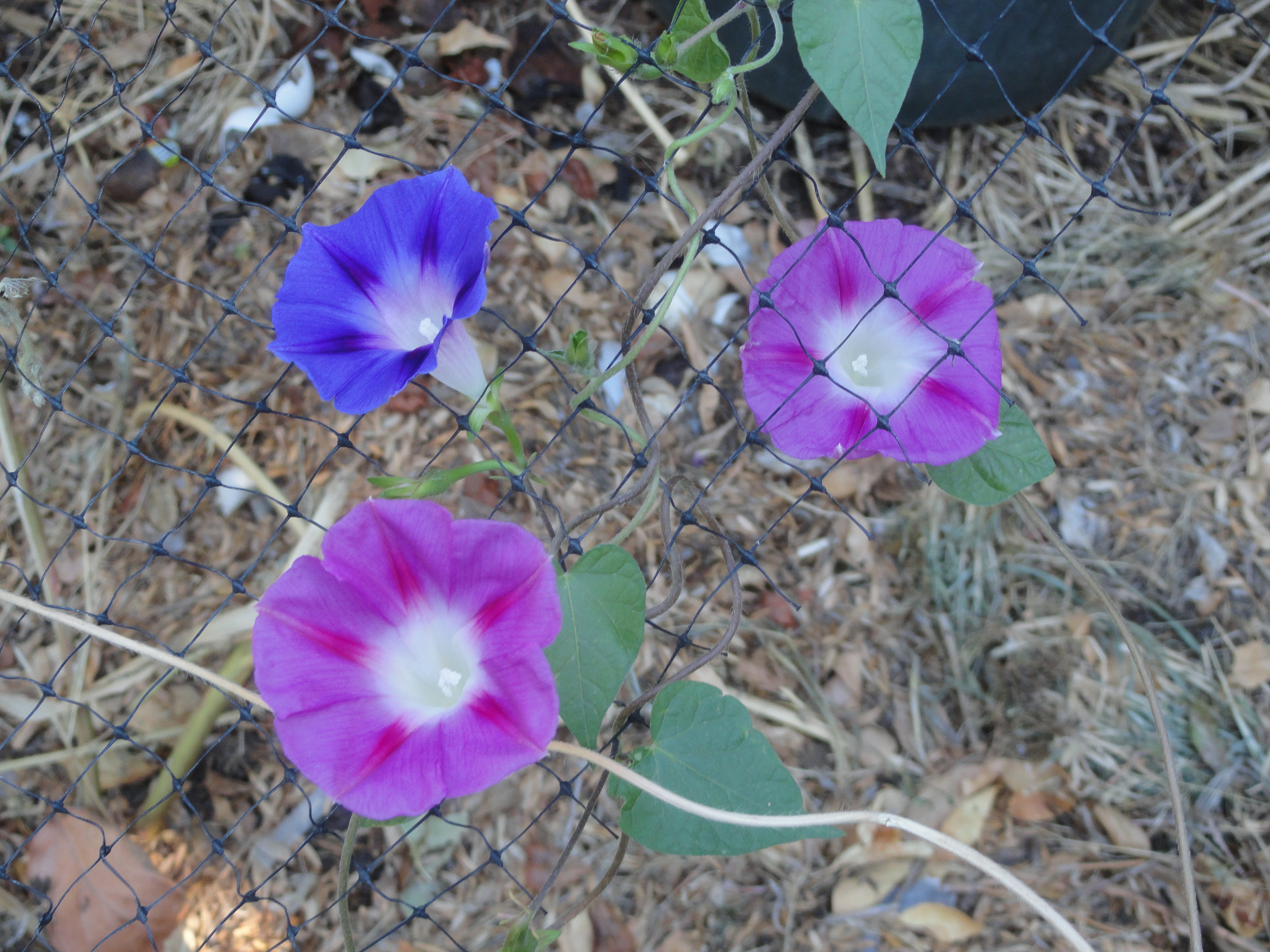
photo by Sandra Dodd, of three fleeting flowers

Monday, June 11, 2012

Play with words


Playing with words makes them come to life.

The history of England, of math, of writing, of counting.... Any portal into the universe is as real as any other. If an interest in language or butterflies or patterns or water creates connections for that person to anything else in the world, that can lead to EVERYTHING else in the world.


A parent cannot decipher the whole world for her child, but she can help him begin to decipher it.

SandraDodd.com/etymology
photo by Sandra Dodd, in a park in Bangalore

Sunday, April 15, 2012

Odd combos


The connection between humor and learning is well known. Unexpected juxtaposition is the basis of a lot of humor, and even more learning.

It can be physical, musical, verbal, mathematical, but basically what it means is that unexpected combinations or outcomes can be funny. There are funny chemistry experiments, plays on words, math tricks, embarrassingly amusing stories from history, and there are parodies of famous pieces or styles of art and music.

SandraDodd.com/playing
photo by Sandra Dodd, one day at Goodwill

Sunday, March 11, 2012

How will their learning be used?


Pam Sorooshian wrote this:

The time spent mothering and playing is not time away from real learning—not to be rushed through to get to "the good stuff" as some may think of it. It is essential to real learning and, really, to allowing the child to grow up as a whole, integrated human being.

Homeschoolers think a lot about learning—but they often focus on learning to read, write, do math, or learning science or history, etc. Unschoolers tend to take that kind of learning for granted, it happens along the way. Instead, as we get more and more into unschooling, we tend to focus on things like kindness and creativity and honesty—all those character traits that will determine "how" their learning will be used in their lives.
—Pam Sorooshian

SandraDodd.com/nest
photo by Sandra Dodd

Friday, February 25, 2011

Playing for real


Playing with words makes them come to life.

The history of England, of math, of writing, of counting... all clued above and in all the histories of words. Any portal into the universe is as real as any other. If an interest in language or butterflies or patterns or water creates connections for that person to anything else in the world, that can lead to EVERYTHING else in the world.

A parent cannot decipher the whole world for her child, but she can help him begin to decipher it.

SandraDodd.com/etymology
photo by Sandra Dodd, of a sign in The Mercer Museum
in Doylestown, Pennsylvania