Showing posts sorted by date for query /philosophy. Sort by relevance Show all posts

Tuesday, July 7, 2026

Trust the process

Tina Bragdon wrote:

We attachment parented, but in terms of unschooling I at first thought of it in terms of a non coercive "natural" way of getting academics. Now, I can really see how extending the philosophy to relationships and your family atmosphere sets such an important underlying backdrop to learning, and unschooling running smoothly. I can see all that now looking in retrospect. Same thing with just growing in trust in the whole process.... I see so many homeschooling aquaintances fretting about how their kids are going to learn to read, how to "motivate" them to "do schoolwork", and everything about this seems to come from such a place of fear and stress and molding your kids into an end product.
—Tina Bragdon

SandraDodd.com/surprise
photo by Stacie Mahoe

Sunday, June 14, 2026

Philosophy of unschooling

Joyce Fetteroll wrote:

I guess I'd never really thought about the philosophy of unschooling specifically to write it out! A philosophy is sort of a package of principles. And principles are ideas that are accepted (hopefully because someone has experiences and thought deeply about the ideas!) as true.

The principles of unschooling are that humans are born learners. That children will learn best when given the freedom to learn what, when and how they want.

That doesn't, of course, tell anyone what to do. Principles are what help us decide which choices support our philosophy and which choices run counter to it.

. . . .

The principle that some are having problems with is that when children are treated with the same respect that we give to other human beings, life (and unschooling) is enhanced.

It's not a principle anyone should just accept. But those of us that are living it have experienced life with and without that kind of respect and know how wonderful the change can be. Those who have only experienced conventional parenting are only guessing at the effects it will have on children and family life and are rejecting the principle without experience.
—Joyce Fetteroll

Unschooling Philosophy, at Joyfully Rejoying
(an archived page, but even the randomizer still works there)
photo by Karen James

Thursday, March 19, 2026

Facilitator and companion

I’ve been credited with the description below, but it was written by Joyce Fetteroll and tweaked by Pam Sorooshian and me before it was published at the UnschoolingDiscussion site, on googlegroups:

Although unschooling is often described as a homeschooling style, it is, in fact, much more than just another homeschool teaching method. Unschooling is both a philosophy of natural learning and the lifestyle that results from living according to the principles of that philosophy.

The most basic principle of unschooling is that children are born with an intrinsic urge to explore — for a moment or a lifetime – what intrigues them, as they seek to join the adult world in a personally satisfying way. Because of that urge, an unschooling child is free to choose the what, when, where and how of his/her own learning from mud puddles to video games and SpongeBob Squarepants to Shakespeare! And an unschooling parent sees his/her role, not as a teacher, but as a facilitator and companion in a child’s exploration of the world.

Unschooling is a mindful lifestyle which encompasses, at its core, an atmosphere of trust, freedom, joy and deep respect for who the child is. This cannot be lived on a part-time basis. Unschooling sometimes seems so intuitive that people feel they’ve been doing it all along, not realizing it has a name. Unschooling sometimes seems so counterintuitive that people struggle to understand it, and it can take years to fully accept its worth.
—Joyce Fetteroll, aided by
Pam Sorooshian
and Sandra Dodd

SandraDodd.com/unschooling
photo by Clare Kirkpatrick

Monday, August 25, 2025

Helping one another grow

Of her birth family, Rippy wrote:

My family used to regularly travel to India to a Sikh ashram where we were encouraged to examine our thoughts and words. The philosophy there was that helping one another grow into more loving, mindful people is one of the greatest acts of service one can do.
—Rippy Dusseldorp Saran


Kinder and More Compassionate

Tuesday, August 12, 2025

Happily and successfully


Pam Sorooshian wrote:

Unschooling happily and successfully requires clear thinking.
. . . .
Unschooling well requires understanding the underlying philosophy of how children learn, and the principles that guide us in our everyday lives arise from that philosophy. It isn't some new kind of parenting technique that can be observed and applied without understanding.
—Pam Sorooshian

SandraDodd.com/understanding
photo by Janine Davies

Friday, June 6, 2025

Sorting real from construct

Most of unschooling has to happen inside the parents. They need to spend some time sorting out what is real from what is construct, and what occurs in nature from what only occurs in school.

Unschooling and Yoga Philosophy – An Interview with Sandra Dodd
photo by Cally Brown

Wednesday, April 16, 2025

All fun and games

An angsty mom wrote:
I know in the nitty gritty of my heart, I'm not okay with a life philosophy that centers on "if it's fun I'm here, and if it's not, I'm gone."
Joyce Fetteroll responded:
Don't think of what we're talking about as fun, then. Think of it as joy. Or fulfilling. Or satisfying.

Even the most joyful life isn't all peaches and cream. Sometimes it rains when we wanted it sunny. Sometimes a friend cancels when we wanted to do something together. Sometimes accomplishing something means working through a period of frustration.

Life will naturally throw lemons at us fairly regularly. But what we don't need is to squirt life with artificial lemon juice to prepare us.
—Joyce Fetteroll

There's more: Life can't be all fun and games
photo by Karen James

Monday, January 27, 2025

Philosophy and principles

Joyce Fetteroll wrote:

The core idea of the unschooling philosophy is that humans are born learners. That's what John Holt observed over and over. Children will learn best when allowed to learn what, when and how they want.

That doesn't, of course, tell anyone what to do. The philosophy helps you make choices. The principles -- such as peace, trust, respect, support, helpfulness -- help you stay on course when situations make it difficult to.
—Joyce Fetteroll

The unschooling philosophy
photo by Christine Milne

Friday, December 27, 2024

People, growing as people

Tina B/canuckgal wrote in 2008:

We continue to come to this life bit by bit as well. I think for us it is an extension of attachment parenting philosophy, about what we believe about children and childhood and about our children as PEOPLE, not them as little beings who fall short and need to be prepped for adulthood while totally ignoring or negating the living and learning they are doing TODAY....
. . . .

I love how the whole philosophy (not just the "academic" aspect) has made ME grow as a mom and person, and I hate to think where our family would be had we not come across it. Yes, I have had my bad days and doubts, but certainly I would not be as happy as I am now.
—Tina B/canuckgal

SandraDodd.com/gettingit
photo by Roya Dedeaux

Friday, November 15, 2024

Amusement is good

Holly said to me one day something like "Friends come in and out of your life like busboys in a restaurant." WOW, I thought. That helps! That helps when I'm sad that someone is slipping out of my daily life. I told her it was pretty wonderful and she said it was a Stephen King line from "The Body."

People come and go and we change each other. We amuse each other if we're lucky and frustrate each other if we're not so lucky.

SandraDodd.com/philosophy
photo by Cátia Maciel
__

Friday, July 26, 2024

Philosophy and priority

Questions come up about how a parent can help teens do things they want to do. Here is an example from when I had two teens and one nearly a teen.

It has to do with philosophy and priority. I think the way I discuss whether one of my teens can go to a movie or not under the circumstances of the moment is as true and deep a life-building experience as when he asks me what squares and square roots are about.

2024 note: Truer and deeper than facts that can be discovered anywhere, anytime. Looking back, I see its importance more clearly.

One day we had from seven to seventeen kids here, in various combinations and not all at once. It was a madhouse. Seven was my low count because there are still seven here at the moment. At one point two were gone and were coming back, one was half-expected (and did show up) and Marty wanted to go to the dollar movies to see "School of Rock" with a subset of the day's count. Holly didn't want to go; her guest from England did. Kirby half wanted to go; the girls coming back wanted to see him particularly. So the discussion with Marty involved me helping him review the schedule, the logistics of which and how many cars, did he have cash, could he ask Kirby to stay, could we offer another trip to that theater the next day for those who'd missed it today, etc. I could have said "yes" or "no" without detail, but it was important to me for it to be important to Marty to learn how to make those decisions. Lots of factors.

That's part of my personal style of radical unschooling.

Today: The day this is scheduled to go out, Keith and I will have three grandkids from 8:00 to 1:00, and then the other two at night. There are logistics involved. The oldest grandchild is being paid to come back and help at night. Drivers, food, activities, re-staging between...

Same goals as in the 2003 story above—fun, peace, contentment.

From longer writing, third comment at
SandraDodd.com/unschool/radical
photo by Kim Jew Studios
in those days, but not that day

Saturday, March 30, 2024

Replacing a canvas

Dawn, in Nova Scotia, wrote:

Ok, I think I'll share my newly-thought-of philosophy of housework here. It started when my sister was over and chasing the kids around. I was straightening up the livingroom and had just finished piling up blocks (big cardboard ones; we have, in all, ten or eleven different kinds of wood, plastic and cardboard blocks. I feel so wealthy. 🙂) when my son (2) ran into the room, saw the blocks and immediately tore down the pile. I smiled and shook my head. My sister, who'd arrived in time to see this, sternly said, "Harry! Your mother just finished putting those away!" When she said that I felt offended. Didn't she know I only pile those blocks so that Harry can knock them down? And there was the Aha! I looked around the room at the clean living room and realized that was why I did any cleaning.

We don't clean up messes to have a clean house. We clean up messes so there is room for more mess!

Now I think of cleaning up after my kids as replacing a canvas. I do it with the thought that by giving them room again and a bare floor and organized toys to pick from, I'm handing them the tools to write another mess onto our house. It's meant that at the end of a day, or sometimes a few days in a row, I just let the mess stay, because really, it's a work of art or a story. Maybe it isn't finished. Maybe it's too interesting to be gotten rid of so soon. It also clears up my feelings of resentment about doing the bulk of it. I like being the one to reset the house so that we all can live another, different mess the next day.

Anyway, thought I'd share since it's really helped me bring more joy into the housework!

—Dawn (in NS)

SandraDodd.com/chores/intro
photo by Sarah S.

Thursday, February 1, 2024

Being, in balance

Sandra, about Always Learning (the discussion list referenced):

I think finding balance is probably the hardest thing. It's easy to make an extreme caricature of "being an unschooler" rather than finding a way to live unschooling. Someone recently assured us she was "doing it," but having someone else say "that's it, you're balanced on that bicycle" is worthless if the bicycle falls over. There's doing, and there's being, and there's "it," and the reason this list exists and thrives is that those ideas (doing, being, "it") live in the realm of philosophy, of the examination of ideas, of the weeding out of error and fallacy.

Half of me says "bummer" and half of me says "cool!" and so at the balance point of those two, we continue to discuss unschooling.

SandraDodd.com/control
photo by Linda Wyatt

Wednesday, August 23, 2023

More or less

Leah Rose wrote:

I've been thinking about that saying "All things in moderation." Next time someone says it to me, I think I might just ask them: "Do you mean we should have joy in moderation? Should we have peace in moderation? Kindness in moderation? Patience in moderation? Forgiveness? Compassion? Humility?"

Honestly, I used to think it sounded like a very wise and balanced philosophy. Now, the more I think about it the less sense it makes.
—Leah Rose

Moderation
photo by Sandra Dodd

Wednesday, June 21, 2023

Food and its purpose

[When my children were little...] I always put the kids' needs ahead of dinner. Dinner happened after or around nursing babies and such.

You might have to do away with the idea of a peaceful mealtime for a few years. Maybe re-thinking meals would be the way to go.

I think it helps rather than to live by the idealized traditional model of dinner at 6:00, all at their seats, dinner conversation that could be reported to the media as an ideal mix of news of the day and philosophy, etc, to think of food and its purpose. People need to be nourished physically and it's uncomfortable to go to sleep hungry. THAT is the purpose of evening food, not the appearance of a well-organized dinner.

SandraDodd.com/eating/dinner
photo by Sandra Dodd, of one of the former Dodd babies

Friday, March 24, 2023

Another step; another

Those who divide the world into academic and non-academic will maintain rules, bedtimes, chores even though they might not be "having lessons" in history, science, math or language arts.

So the history of "radical unschooling" came from someone saying "Well we're not that radical," and me saying "well I am."
I think if people divide their lives into academic and non-academic, they're not radical unschoolers.

I think unschooling in the context of a traditional set of rules and parental requirements and expectations will work better than structured school-at-home, but I don't think it will work as well for the developing souls and minds of the children involved.

And those who are not radical unschoolers would look at that and say "What do their souls have to do with unschooling?"

It has to do with philosophy and priority.

What do you believe is the nature of man, and the duty of a parent?

What do you believe hinders a child, or harms the relationship between a parent and a child?

Real actual unschooling
photo by Cathy Koetsier

Wednesday, October 5, 2022

Imaginary advisors

Sandra Dodd, on stored internal messages:

I think of whose voices I've let speak back to me when I'm wondering what to do, what cartoonish characters are in the peanut gallery of my conscience. I have Mr. Jamison who was the best voice coach I ever had. That's when I'm singing, or sometimes when I'm getting gushy about certain kinds of music and a voice (Sam Jamison's) says it's pap. I don't always agree with him, but I wrestle his opinion lots of times when I don't expect to need to.

I have lots of former best friends, neighbors, teachers, relatives. Some have to sit in the dark back rows, and I don't listen to them as much as I once did because I decided their advice was bad. Some are totally situational (music, or money, or cooking). Some are more about philosophy and ethics and compassion, so they sit up in front with the light on them more often.

I don't mind being one of the council of imaginary advisors anyone has. I just hope they'll listen to lots of voices and not follow any of them without really thinking about it or understanding why.

Use your words (with a great comment)
photo by Sandra Dodd

Friday, April 1, 2022

Many things

Few things are just one thing. Most things are many things.

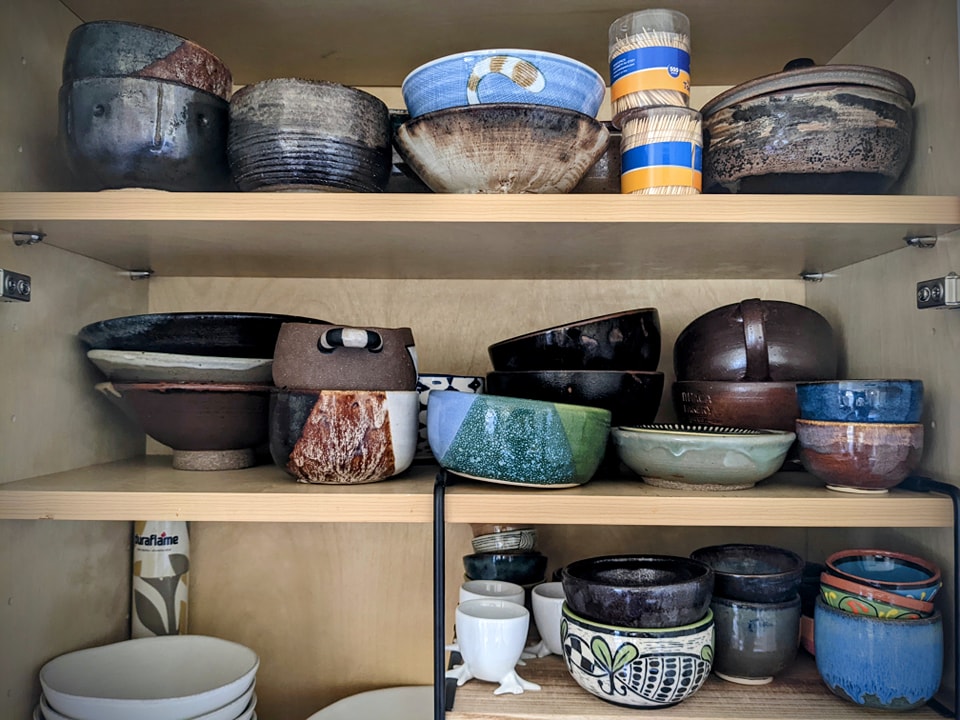
Karen James is doing ceramics these days, and so her bowls are a hobby, a collection, a puzzle to fit safely into the cabinet, or efficiently into the dishwasher. They are also dishes, and bowls.

Thinking about what things are is philosophy, and language, and a puzzle.

Liking your dishes is good for your mental health. Liking hobbies, collections and puzzles will make life better.

SandraDodd.com/dishes
photo by Karen James

Sunday, June 6, 2021

Loving, gentle and sweet

Of the Always Learning discussion,Rippy D. wrote:

For me, this list is like being in a graduate class at university about unschooling. A rapid flow of ideas, critical examination of those ideas and the encouragement to really think your thoughts through. Fortunately, it is a free university run by expert volunteers that make sure the discussion stays firmly on the philosophy of unschooling, attentive parenting and what will help unschooling and what will hinder it. I learn every day how to have a better partnership with my children and spouse, how to connect, inspire, trust and help. And now that I have learned how to read without my emotions interpreting the emails for me, the message is consistently the same — be loving, gentle and sweet with your children, *be* with your children, live joyfully.
—Rippy Dusseldorp

Learning to read on the list, by Rippy Dusseldorp
photo by Roya Dedeaux

Friday, January 31, 2020

Your own clear understanding


Pam Sorooshian wrote:

Unschooling happily and successfully requires clear thinking. I don't think it works as well when people just look at those with young adult kids who are happy and successful and try to copy them without doing the hard thinking and building their own clear understanding of unschooling. When they try to emulate, they are still following rules - unschooling rules. Unschoolers always say yes to everything. Unschoolers never make their kids do anything. Kids always decide everything for themselves. And so on. But those "rules" are not unschooling. Unschooling well requires understanding the underlying philosophy of how children learn, and the principles that guide us in our everyday lives arise from that philosophy. It isn't some new kind of parenting technique that can be observed and applied without understanding.
—Pam Sorooshian

SandraDodd.com/understanding
photo by Belinda Dutch