In a discussion about things unschooling parents have learned from their kids, I told a story involving my Uncle Billy Jack, a fun guy I didn't see much:
When I was a kid, 10 or so, my mom's youngest brother (who was probably 24, 25 at the time) asked me "What's the capital of South Dakota?"
I said "I don't know, what is it?"
He said "I don't have to know—I'm not in school."
That moment is branded in my brain.
I went and learned it [Pierre, SD] when I got home, and haven't forgotten, though it will NEVER matter to me in any way whatsoever. It's trivia disguised as "knowledge." But the idea that there were things kids needed to know and adults didn't care anything about stayed with me.
Unschoolers see their kids learning all kinds of things joyfully, for fun. I'm definitely NOT opposed to trivia. Trivia means "it won't be on the test." Without tests, everything can be entertaining trivia.
What is trivia? For school kids, trivia is (by definition) a waste of time. It’s something that will not be on the test. It’s “extra” stuff. For unschoolers, though, in the wide new world in which EVERYTHING counts, there can be no trivia in that sense.
So what IS trivia? For school kids, trivia is (by definition) a waste of time. It’s something that will not be on the test. It’s “extra” stuff. For unschoolers, though, in the wide new world in which EVERYTHING counts, there can be no trivia in that sense. If news of the existence of sachets ties in with what one learned of medieval plagues in Extraordinary Endings of Practically Everything and Everybody, there are two pointers that tie microbiology to European cities in the Middle Ages, and lead to paradise-guaranteed pilgrimages to Rome. Nowadays sanitation and antibiotics keep the plague from “spreading like the plague.”
So what IS trivia, then? For school kids, trivia is (by definition) a waste of time. It’s something that will not be on the test. It’s “extra” stuff. For unschoolers, though, in the wide new world in which EVERYTHING counts, there can be no trivia in that sense.
The whole world is made of little bits of information. Yesterday, at my house, Holly asked who first did "Dream Lover." I was thinking someone like Dion, or Bobby Vee, and while I was thinking she said "Bobby Darin," and I said no, not first.
Spoiler: I was wrong.
She pulled the computer out of her pocket, looked the song up, and played the beginnings of a couple, on Spotify. "That one!" I said, to the one by Dion. It listed Ben E. King, among others, so we figured (falsely) that it was his first, THEN Dion, then Bobby Darin.
Does it matter? To us, it does. To music history, and royalties, it matters. As to political correctness and the basis of assumptions, it ties in to all sorts of socio-political, economic, maybe geographical aspects. Trivia is what knowledge is made of. Enough little bits form a rich whole.
We could each explain why we thought what about whom, in all that. Those explanations would lead to other trivia, stories of other songs, writers, and musicians.
Any interest can lead to all interests. Let curiosity flow.
These will (while they're there) link to recordings at YouTube, but if you have Spotify or another music service, you can find recordings by these and many other people. There are other songs with similar names, too. I will embed Bobby Darin's version, because he wrote it, but it's not the one I knew as a kid.
History, science, gardening, tradition, the physics of simple machines, color, art, children's games, materials, geography...
No matter what topic you choose, what collectable objects you favor or trivia that appeals to you, following that interest will lead you to many "facts" and "truths." Trivia perhaps, but enough trivia will create a detailed model of the universe.
So what IS trivia, then? For school kids, trivia is (by definition) a waste of time. It’s something that will not be on the test. It’s “extra” stuff. For unschoolers, though, in the wide new world in which EVERYTHING counts, there can be no trivia in that sense.
The edition of The New York Public Library Desk Reference we have might be a little outdated, but the rules of ice hockey haven’t changed, nor the way in which one addresses a letter to the Pope, nor the date of the discovery of Krypton. (Some of you thought it was just a Superman thing, didn’t you? Nope—1898, the year before aspirin.)
(Before the internet, people had reference books, and even then they seemed like trivia. Trivia can be the interesting door that leads to strange, new knowledge.)
As they got older, and war games, movies about history, and international celebrities came over their intellectual horizon, so did trivia about the borders of countries.
What's with Tibet? Taiwan? When did Italy and France settle into their current borders? Why does Monaco have royalty? The Vatican really has cash machines in Latin? What's the difference between UK and Great Britain? Is Mexico in north or central America? Were Americans REALLY that afraid of and ignorant about the Soviet Union in the 60's?
In answering those questions, the terms and trivia of history, geography, philosophy, religion and political science come out. The words are immediately useful, and tied to ideas and pictures and knowledge the child has already absorbed, awaiting just the name, or the definitions, or the categories.
Sometimes to understand a joke, people have to know three or four different things already. Sometimes a piece of humor ties together LOTS of trivia/learning in ways other things can't do.
Kirby reads like a lawyer. He can skim a rules book or instructions for a game, and explain simply and clearly to others. If he forgets a detail, he'll be able to find it easily.
Marty likes humor and history.
Holly's main reading is on the internet, but she likes name books, and other non-fiction and trivia. One thing she doesn't use the internet for is definitions and spellings. She likes my old full-size American Heritage Dictionary, and will sprint upstairs to look something up on the slightest excuse.
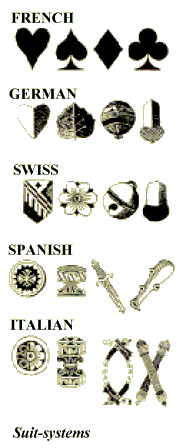
By seeing the same old things in new ways, you might discover a world of riches in the same old stuff you already had. Take, for instance, a deck of playing cards. What might seem too mundane and common to you isn't so common to someone else. And maybe your parents or grandparents thought cards were sinful, but playing dominoes or something else was okay. My dad's family was that way.
Playing card games has social benefits and leads to learning and all, but playing around with the cards themselves leads to dozens of things too! Compare aces and art from different decks. Consider the manufacture of cards, the traditional colors, the etiquette of card tables, shuffling, cutting, directions of play.
Cards connect to history, art, statistics, logic, geography, religion, law, entertainment, paper manufacturing, printing technology... well they don't connect to more things than everything else does, but they're an easy way to see how things connect!
Some languages are simpler than English in that the letters and sounds match pretty consistently. French and Spanish come to mind. German. But because of something that happened in 1066, and because of the history of The British Isles, and because of the isolation of some English speakers and the migration of many others, English has complexities and a crazy-large vocabulary. Our basic grammar and language are Germanic. The majority of our vocabulary is from French (look up 1066 if you don't remember what happened) and Latin, though the everyday words we use are from Anglo Saxon, which had borrowings from half a dozen Germanic dialects.
If that was a painful paragraph to read, never mind it. If that paragraph was fun for you, then you can help your children spell by looking up what language a word is from and figuring out why it looks the way it does in written English.