
photo by Sandra Dodd
___


When kids get sneaky, what might that signal to a parent?Joyce responded:
Don't see his behavior through adult eyes. That view casts children as the bad guys when they disobey what adults want them to do. See the behavior for what it is. He has a need. He sees you as an obstacle, as someone who not only won't help him meet his need but will probably stop him. So he's avoiding the obstacle to try to meet the need himself.
It's the essence of every story: The protagonist has a need. He finds ways around what stands between him and what he needs.
Rather than being an obstacle, be his partner in meeting his needs. Be the one keeping an eye on the needs of those around him as you find respectful, safe, doable ways for him to meet his needs. Be the one manipulating the environment so he's not in a situation he can't handle yet.—Joyce Fetteroll
SandraDodd.com/needs


In the dark? Feel your way blindly?
How will you know which way to go?
Probably it would be better to gather ideas that will help with decision-making and then make decisions in the bright light of everything you know, and the way you would like to be.

"Your child is not you"—that one stopped me cold, way back, when I was resisting, thinking it All sounded odd and crazy. It was a gigantic "well duh" moment in the best way. It was so obvious! And yet I was using my adult needs and fears waaaaay too much to make decisions about what my kids "needed" or "needed to learn".—Meredith





At what age did you begin providing regular social interactions with other children?I will say "from birth" and then I will ask you to replace "other children" with "other people."

I tend to err on the side of just spending time together.Don't think of it as erring.


On the first day being with us, my aunt said, "Don't you two ever put that baby down?" On the third day, she said, "That's the happiest, most alert baby I've ever seen!"


Flat representations can't show these connections. Neither could an elaborate three-dimensional model, because when you consider what a thing is or what it's like, you not only make connections with other concepts, but experiences and emotions. You will have connections reaching into the past and the future, connections related to sounds, smells, tastes and textures. The more you know about something, the more you can know, because there are more and more hooks to hang more information on—more dots to connect.
I got the idea for this kind of graph from Trust the Children: A Manual and Activity Guide for Homeschooling and Alternative Learning by Anna Kealoha.
Here's a simple mathematical example:
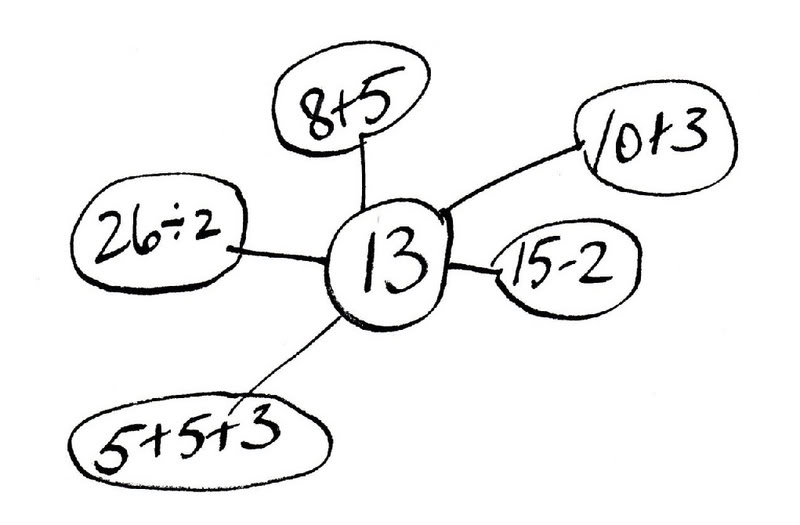
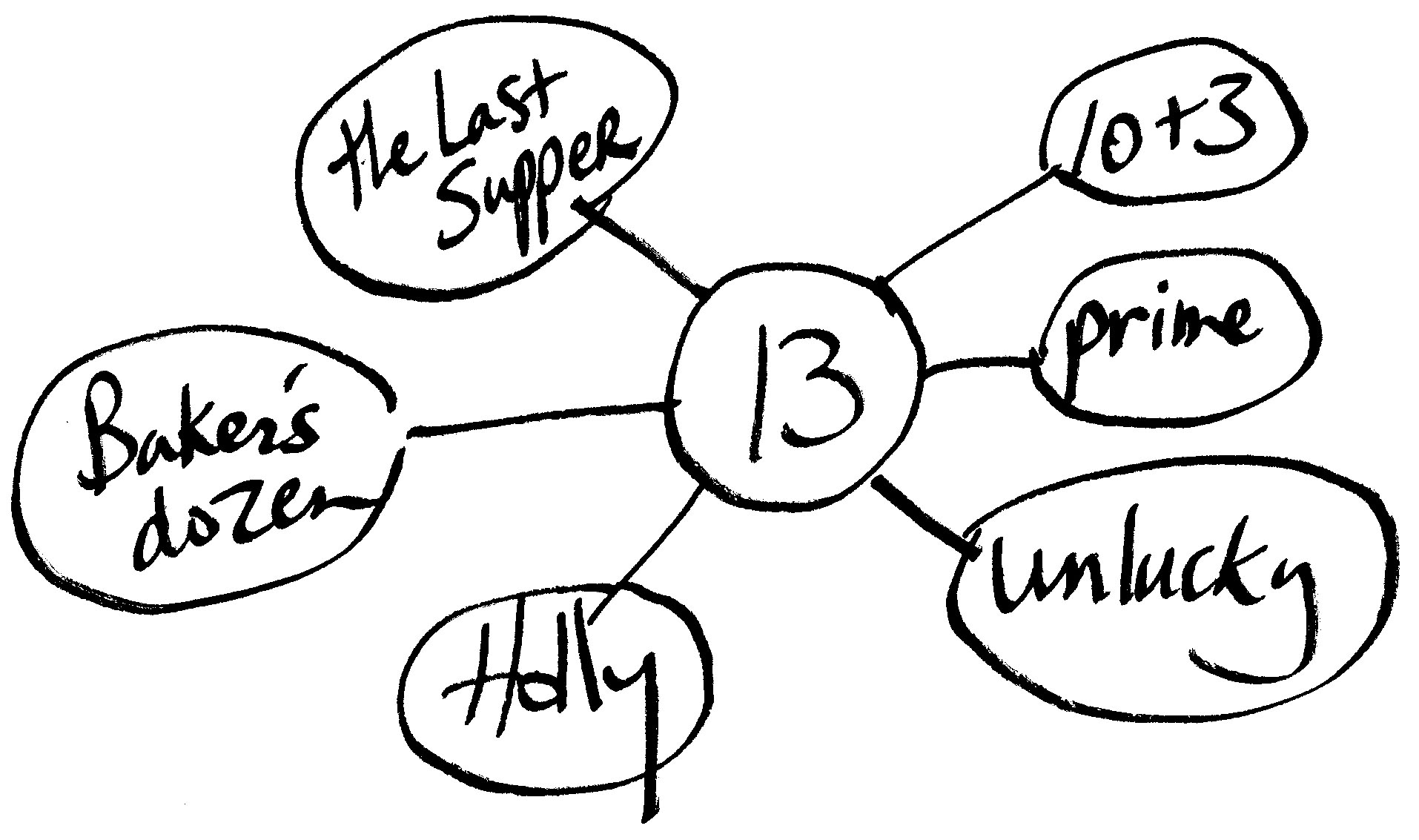
And any of those can become "the center" and branch out to everything else in the whole wide world. But at the heart of this exercise is what is and what isn't: What IS a thing, and what is not the thing? What is like it and what is unlike it?


