Showing posts sorted by date for query eating. Sort by relevance Show all posts

Friday, August 28, 2026

Trust and faith

A mom trying to persuade another mom to let kids have choices wrote:

But children don't die from eating too many Oreos or spending a whole day watching Kipper videos. They might get sick, or feel headachy, or be grumpy, but it's not life-threatening.

I responded:

They're entirely UNlikely to be sick, headachy or grumpy from those things. They are very likely to feel smaller, and worse, from parental restrictions and from hearing "no," though. And if the mom's dire warnings of doom turn out not to have been true, then trust and faith fall and are hard to restore.

Trust and faith are the most powerful tools parents of teens have. Too many parents squander those trying to control toddlers and young children.

SandraDodd.com/choice
photo by Sandra Dodd

Monday, August 17, 2026

There is no trick

Renee Cabatic, July 2010:

We were at a bar-b-q party and a 5-yr-old friend dug into the cooler, pulled out a Coca-cola and asked his Ma could he have it.

She said, "Heavens no, especially with that chocolate cake on your plate."

She then looked at me, asking, "How do you do it?"

I told her, "I don't restrict what my kids eat," and pointed to their plates. ]XuMei had watermelon, strawberries, green beans and chocolate cake on her plate. Xander had chosen salmon, corn on the cob, watermelon, strawberries and a root beer to drink.

Later I was telling Chris (my spouse) the story and Xander, who I thought was asleep in the back of the van, perked up and said, "The trick is, there is no trick."
—Renee Cabatic

SandraDodd.com/eating/candid
photo by Christine Milne

Friday, August 14, 2026

New answers to old questions

PamG wrote:

We went out to eat at Olive Garden last night and the boys got this activity sheet/menu to do while we waited. It had a crossword puzzle on it and we were doing it. I was reading the questions and the boys were answering. Questions like "Spaghetti is a _________." Well, the last question was "Clean your __________." My boys had no idea what that could be that would deal with food.

I gave them the answer, then looked at Jackson. We were both brought up hearing that phrase every day. I am so glad my boys have never heard it.

Sandra Dodd later:

Holly Dodd asked me to read this page to her one night, and she said she would have guessed "Clean your hands" would be good advice about eating, and restaurants.
—Sandra

For those born in the 21st or late 20th century, the "right" answers were probably "pasta" and "[clean your] plate."

SandraDodd.com/eating/humor
photo by Sandra Dodd

Thursday, July 16, 2026

"Rat plate"

Sally Lopez wrote:

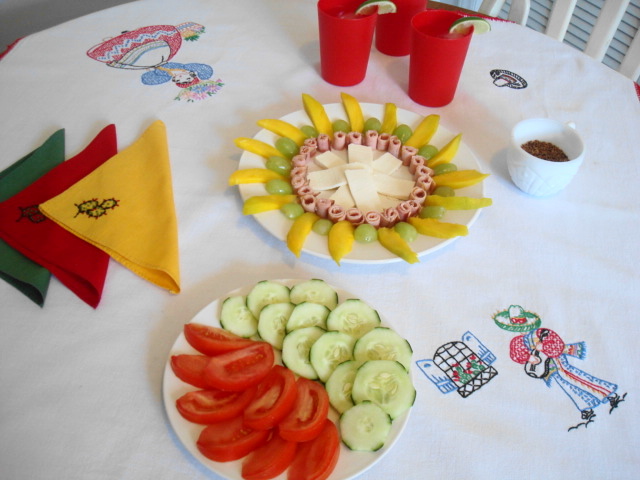
This was lunch for Will (3 yrs), who was busy playing games online, and for Elias (18 mos), who was napping while I was preparing it all, otherwise it probably wouldn't have stayed together long enough to snap a picture. I had a Mexican tablecloth and napkins out already, so I made some snacks with Mexican flavor to look pretty with them. The sunshine-y plate is mango, grapes, chipotle ham, and queso fresco (Mexican cheese). The other is sliced cucumber and tomato, and the little cup is a salt/chile seasoning called Tajín, for sprinkling on fresh fruit or veggies. Results: Will devoured the grapes and cheese at the computer desk and drank the water, but discarded the lime wedge. He licked a piece of mango and sampled some ham, but said it was too spicy. Then he turned off his game and asked for some leftover soup from last night and an ice cream sandwich, which he ate at the table. Elias ate a little of everything except the Tajín. He sucked on the lime wedge for a while.

We call ours a "rat plate." There's a scene in the movie "Ratatouille" where Linguini sets out a little feast for Remy, the rat, with fruit and bread and cheese. After we watched that, Will pretended to be a rat and asked for "rat food."
—Sally Lopez

SandraDodd.com/eating/ratplate
photo by Sally Lopez

Monday, June 22, 2026

Choosing fruit


Bernadette Lynn wrote:

My son isn't restricted in what he eats. He came into the kitchen yesterday to ask me if there were any biscuits (cookies), but stopped mid-sentence when he noticed a melon on the counter and asked for that instead. So he ate a whole honeydew melon, instead of biscuits (which we did have). It's the second one he's eaten since I bought them at the weekend.

The melon was sitting next to his uneaten Easter egg, but he ignored that.
—Bernadette Lynn

SandraDodd.com/eating/sweets
photo of Holly Dodd by Trevor Parker,
text added by Holly later

Saturday, June 6, 2026

Less control, concerning food

Jo Isaac wrote:

Scientific studies show that parents who control food end up passing on a whole set of other problems to their kids - including potentially eating disorders.

For example: The linked study concludes that more controlling parents had children who ate more in general, of both "healthy" and "unhealthy" snacks. Also, children whose parents used food as a manipulator/behaviour moderator (i.e.: do you homework or you won't get any ice cream) were more unhappy with their body and looks.

Other studies have found that children who had their food controlled later were more likely to chose high-fat quick energy foods, and had limited acceptance of new foods, and - most importantly - had no ability to understand cues from their own bodies - they couldn't tell if they were hungry or not.
Moving Toward Less Control, Concerning Food
photo by Christine Milne

Thursday, June 4, 2026

Compassion INside

To have peace in your house, be more peaceful.

Some parents wear their compassion on the outside and say we need peace in the whole world first. That's a little like saying the ocean should be drained before we take the water out of the basement. Does every war have to stop before we can stop hitting our kids? Does every bit of urban violence need to end before we can stop yelling at our kids? Do lions have to stop eating gazelles before we stop harassing our kids? To think in those terms is to justify our own lack of peace. It seems to me that a child who has known strife at home won't blink at it outside.

SandraDodd.com/peace/noisy
photo by Cátia Maciel

Tuesday, June 2, 2026

Learning to live

You don't know exactly what your children need. They won't know either, if they're never allowed to live in such a way that they will learn to pay more attention to their bodies than to a book or a menu, calendar or clock.


SandraDodd.com/eating/purpose
photo by Sandra Dodd

Tuesday, April 14, 2026

Thinking and watching

Annie Kessler wrote:

I used to honestly believe that my son was really sensitive to sugar and that consuming it changed his behavior in negative ways. Then someone (at an unschooling conference) mentioned some of these ideas—how sometimes we blame behaviors on something like sugar but the problem is really *our* own perception of what is going on and not the actual reality of what is happening. They said it more clearly than that, but that's what I took away from it and when I really thought about it and examined the situation and really watched my child I could see that it was true.
. . . .
I am glad that someone pointed this out to me and that I was ready to hear it at the time. I'm glad to see some of the same ideas coming up here because there might be someone else like me out there.
—Annie Kessler

SandraDodd.com/eating/sugar
photo by Sandra Dodd
cupcakes decorated by younger Devyn Dodd

Thursday, April 2, 2026

Eating food

Gwen Montoya, Easter 2014

This morning my kids woke up to Easter baskets with a DVD they have been wanting and lots of their favorite chocolate (different kids, different tastes).

So far, my oldest has eaten two waffles with peanut butter and two ham & cheese sandwiches. And two pieces of candy from her basket.
. . . .
They are excited about the DVD's, but have been hiding eggs, playing with Matchbox cars, and performing science experiments on Peeps. Not watching the movies.
—Gwen Montoya

There's more:
SandraDodd.com/eating/sweets#gwen
photo by Amy Milstein

Wednesday, March 4, 2026

Choosing food

The idea that one can learn to feel and know one's own body and choose foods accordingly is shocking to most people. I wouldn't have thought it sensible or possible, when I was younger, but having given my three children the option to turn down any food, and to try any food, to choose their own quantities of food has shown me a whole different aspect of human learning and instinct.

It should make sense. Early people wouldn't have continued to eat what wasn't good for them if they weren't starving. If they had options, they would have chosen the things that seemed (for whatever range of reasons they might be choosing) good. There are food taboos and preferences all over the world. Some are credited to religion or superstition. Some are medicinal. All were, originally, local.

In a situation in which there is an abundance of food shipped and traded all over the world, then how does one choose? This is what is coming to be called "a first-world problem." In terms of learning, though, in the context of the life of a family choosing unschooling and mindful parenting, the question is answered every time food is bought, presented, consumed or considered.

SandraDodd.com/eating/choices
photo by Sandra Dodd

Wednesday, February 18, 2026

Variable, thoughtful lunch


Some days lunch is medicinal—one child is sickly and could use soup or juice. One is off to a sports event, and carbohydrates are a good idea. One is sad, and would like comfort food. One is bored, and her sandwich could use a face.

Be as loose as a dancer, as variable as an actor, as thoughtful as a chessplayer, when you decide what to make for lunch sometimes!

SandraDodd.com/eating/peace
photo by Hinano

The words are from Little meals make big memories

Friday, January 23, 2026

Never heard of such a thing

Christine Macdonald wrote that she and her daughter had walked to the grocery store once to pick up milk they needed for a recipe:
I had brought a ten-dollar bill (no wallet) I told her we'd have about six dollars left and she could get whatever she wanted with it—she wanted a pomegranate or three artichokes (neither of which we had enough money left for) I told her we could come back later with my wallet and get them or get them now skip the milk and come back later for the milk to finish our cake. She said come back later for the artichokes. When we were at the checkout I said why don't you just get a candy bar or something for the walk home she said no thanks. A mom behind me in line was shocked at the idea of a kid not wanting candy if offered said she never heard of such a thing.
—Christine Macdonald

SandraDodd.com/eating/sweets
photo by Jihong Tang

Saturday, October 25, 2025

Together, happily

Amy Kidwell wrote:

I had always wanted to learn to live in the moment, but it seemed a great mystery. Having my daughter and becoming an unschooler, I finally get it! Most days, anyway... I'm not worried about the future, or fussing over the past. We are living together, happily, every day. What a nice way to be."
—Amy Kidwell

SandraDodd.com/feedback
photo by Sandra Dodd
two birds eating on a lawn and stone walkway

Monday, October 6, 2025

Quickly but gradually...

Instead of just going from lots of control to "do whatever you want," a really sweet way to do it is quickly but gradually. Quickly in your head, but not all of a sudden in theirs. Just allow yourself to say "okay" or "sure!" anytime it's not really going to be a problem.
If something isn't going to hurt anything (going barefoot, wearing the orange jacket with the pink dress, eating a donut, not coming to dinner because it's the good part of a game/show/movie, staying up later, dancing) you can just say "Okay."

And then later instead of "aren't you glad I let you do that? Don't expect it every time," you could say something reinforcing for both of you, like "That really looked like fun," or "It felt better for me to say yes than to say no. I should say 'yes' more," or something conversational but real.

The purpose of that is to help ease them from the controlling patterns to a more moment-based and support-based decision making mindset. If they want to do something and you say yes in an unusual way (unusual to them), communication will help. That way they'll know you really meant to say yes, that it wasn't a fluke, or you just being too distracted to notice what they were doing.

SandraDodd.com/eating/control.html
photo by Cátia Maciel

Tuesday, September 9, 2025

Knowing needs

Anna Black (in Australia, so the cookies and biscuits were same and sweet):
Today we were driving home from the library discussing what we would eat. Usually we go to a cafe after the library, but we are saving money for an aquarium visit on Wednesday so I offered to make milkshakes and cinnamon butter cookies at home, which both kids love. My six year old was enthusiastic, but then said, "I think I'm too hungry for biscuits. I'd like something more filling and not sweet." She ended up having a bowl of tuna and mayonnaise, followed by a milkshake. I am so glad she can listen to what her body needs and choose accordingly.
Sandra, responding to that tuna story:
When kids don't get enough sweets, their bodies need sweets. When sweets are there, but their parents say "no," then their souls need sweets, and love, and attention, and positive regard. When sweets are treated sweetly, then children can choose tuna over sweets.

SandraDodd.com/eating/sweets
photo by Cátia Maciel

Monday, September 8, 2025

How does it balance out?

When children choose their foods, they will choose things you didn't expect!

SandraDodd.com/eating/balance
photo by Sandra Dodd

Saturday, July 26, 2025

Nurturing growth

Each tree grows from a single seed, and when a tree is growing in your yard what is the best thing you can do for it? You can nurture it and protect it, but measuring it doesn't make it grow faster. Pulling it up to see how the roots are doing has never helped a tree a bit. What helps is keeping animals from eating it or scratching its bark, making sure it has water, good soil, shade when it needs it and sun when it needs it, and letting its own growth unfold peacefully. It takes years, and you can't rush it.

So it is with children. They need to be protected from physical and emotional harm. They need to have positive regard, food, shade and sun, things to see, hear, smell, taste and touch. They need someone to answer their questions and show them the world, which is as new to them as it was to us. Their growth can't be rushed, but it can be enriched.

SandraDodd.com/growth
photo by Brie Jontry

Saturday, June 21, 2025

Pleasantly surprised


I was asked:

Did your kids have rules like bedtimes, no candy before dinner ... that sort of thing?

I wrote:

We didn't have those rules, but our kids went to bed every night and didn't eat candy before dinner. It seems crazy to people who believe that the only options are rules or chaos, but our children slept when they were sleepy, and ate when they were hungry (or when something smelled really good, or others were eating), and I was pleasantly surprised to learn that they were able to know what their bodies needed. I grew up by the clock, up at 6:30, eat quickly, bus stop, school, wait until lunch, eat, wait until dinner, go to bed. I had no idea that sleep and food could be separated from a schedule like that, but they can be.

Not so crazy after all
photo by Sandra Dodd

Tuesday, May 13, 2025

Naturally clearer thinking

I (Sandra) wrote:
Try not to go against nature, when you're aiming to "be natural."
[Later in that same discussion] Sandra responding to "I try to model healthy eating."
Healthy eating for an adult woman isn't the same as for a teenaged boy or an eight year old girl or a two year old or an infant.

SandraDodd.com/eating/sugar
photo by Cátia Maciel, in Morocco