Showing posts sorted by date for query sandradodd.com/playing. Sort by relevance Show all posts

Friday, June 12, 2026

Out of order

The past few days have been glitchy, but I was calm, from years of practice.

Yesterday's post was lacking a link to something I think you might enjoy. My question and the beginning of the response are here, and it should link to the rest (but scroll up, there):

Sandra:
why does freeze frame sound like the Ramones or Devo

ChatGPT:
If by "Freeze-Frame" you mean the 1981 hit by The J. Geils Band, I can hear why it might remind you of both Ramones and Devo, even though it isn't really either one.

A few things overlap:...

If I had a graph of the order in which I've learned different kinds of music, it would seem glitchy, too. I'm still figuring out lots of things I missed while I was more involved in traditional music, English ballads, madrigals, and medieval and Renaissance Christmas music. Some of that was singular, or duets. Some was leading groups of people. Keith and I spent years immersed in the Society for Creative Anachronism, and weren't paying much attention to what was new and current.

Keith was in high school, listening to The J. Geils Band, The Doobie Brothers, Steppenwolf and Jethro Tull, while I was at the University of New Mexico, playing in the first iteration of their early music program (then called "The Keller Consort"). I listened to albums, but not much radio. I was "studying" Elton John, Cat Stevens, and Joni Mitchell.

Keith and I have been a couple for over 45 years and have done vocal and instrumental music together, and shared each others' old favorite music. He didn't know anything about Donovan, and I think he knew Paul McCartney and Wings better than he knew The Beatles. I couldn't tell Steely Dan from The Doobie Brothers.

It still works if things are learned out of order. When I was little, I could read music before I could read words. Music is in and around me.

I'm still curious, and I'm still learning.

SandraDodd.com/connections
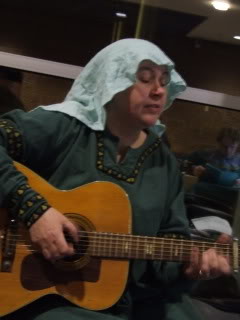
photo by Holly Dodd

P.S. Keith still goes to SCA events and does music. I wandered off.

Sunday, June 7, 2026

Math from My Little Pony

Dr. Christine Alvarado, a science professor at UC San Diego, on how playing with My Little Ponies moved her toward math and engineering:
When I started, I took the hair on the Pony's tail and divided it into three pieces for braiding. Soon I became bored with a single braid. I then divided the tail into nine pieces and made three groups. I braided each group of three until I had three braids, then took these three braids and braided them together.

Soon I was up to starting with twenty-seven pieces (nested down to nine braids, then to three and then one) and then on to eighty-one. All the while I was learning about math: I saw that division is the process of taking a large number of things and grouping them into a smaller number of groups. In order to end up with one even braid at the end, I had to be able to divide the initial number evenly by three, then by three, and then by three again, until I ended up with just one braid.
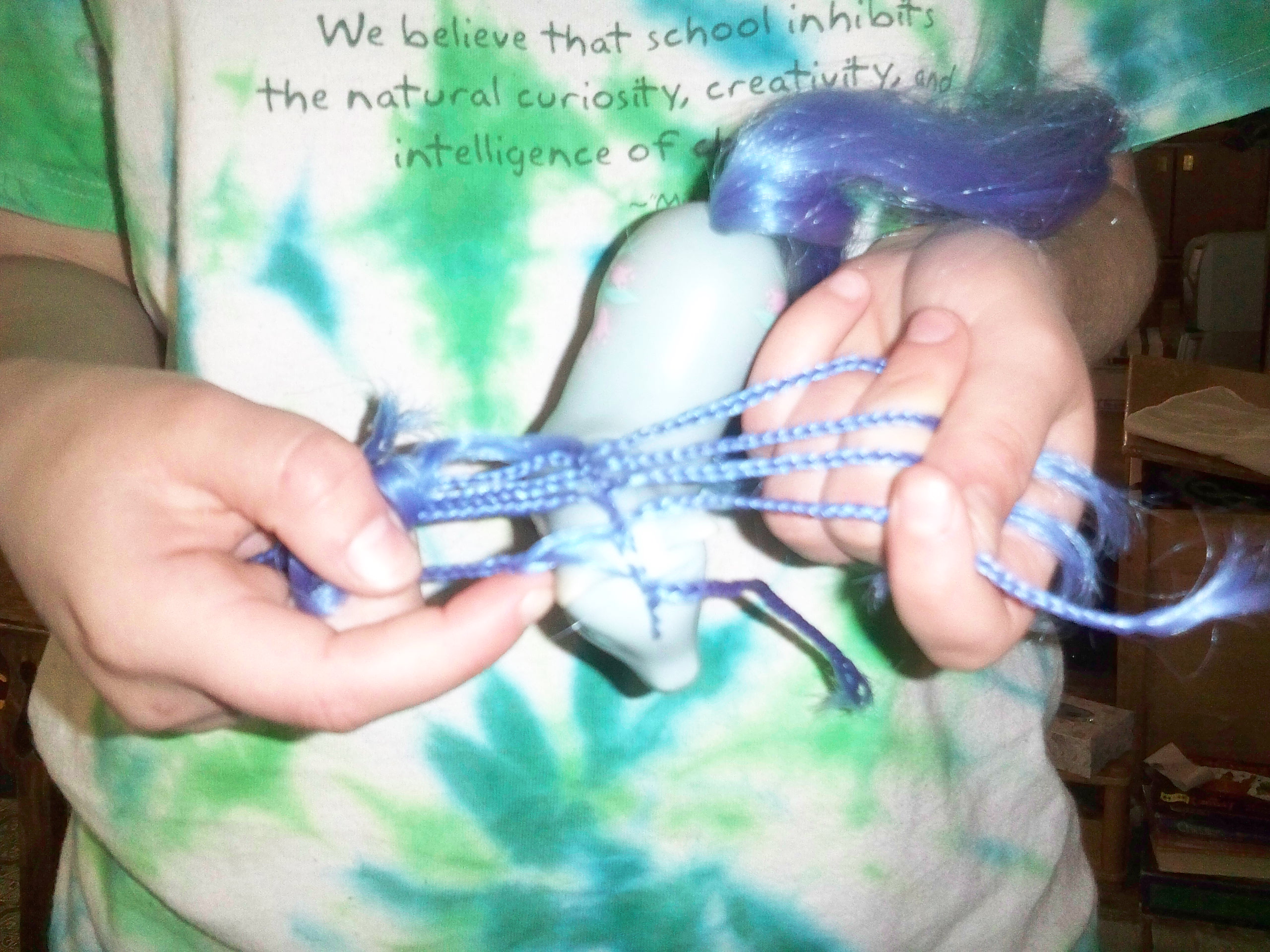
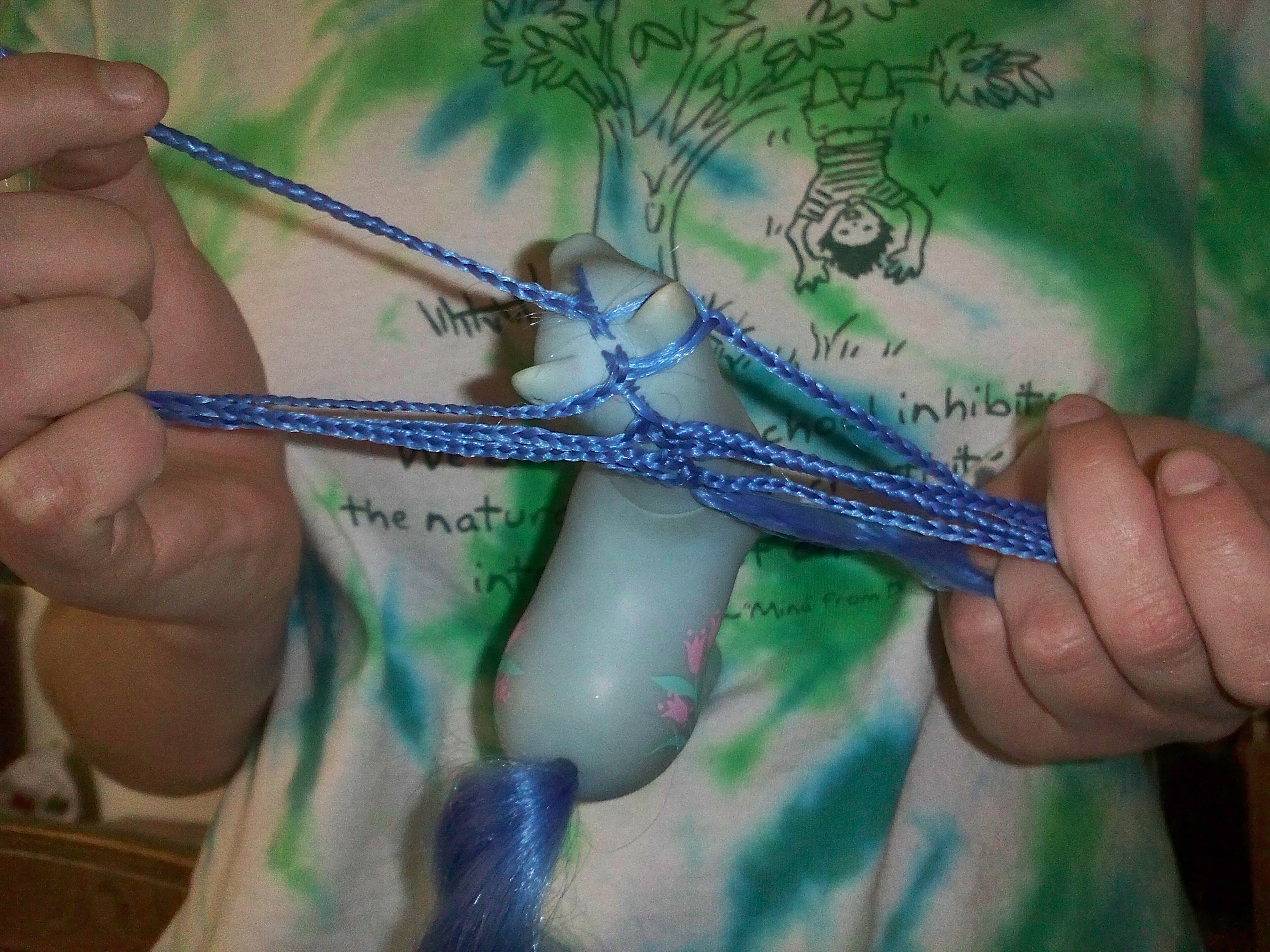
The day after that page was made, I took a photo of some of my daughter's ponies, to use as an illustration at an announcement post, Sleep, Teens, My Little Pony & Science.

Holly, 18, had been away from the house. She came in and saw the ponies out, so I showed her the photo and read her a bit of the Christine Alvarado article. Holly got another pony to show me, told me about the plan of the braids and the angles to get them to cross and stay crossed, and what could be done with those braids, but that she usually twists them into a bun, and had left some unbraided hair out at the bottom of the mane to fasten that bun up with.
I couldn't even keep up with the explanation. Just sayin'... 🙂

There's more of what Christine Alvarado wrote here:
SandraDodd.com/mylittlepony
photos by Sandra Dodd, but Holly did all the braiding

Friday, May 29, 2026

Watching

Jenny Cyphers:

In the newer days years ago, what helped more than anything else was to actually see my kids and what they were actually doing. I would try to see the world from their eyes and see how they lit up and give them more of that. Just being with them and enjoying them for who they were regardless of what they were doing, watching tv, playing dress up, whatever helped keep my energy focused on them, rather than on fear of what they weren't or weren't doing.
—Jenny Cyphers
(original)

SandraDodd.com/jennycyphers
photo by Cátia Maciel

Wednesday, May 13, 2026

Playing as a game

I'm living without a piano these days, but this was true for years, mostly with Clementi, or Bach:

I have said that I play the piano like playing a video game. But what that means for me is that sometimes when I'm passing by the piano, I'll sit down with a piece of music I know fairly well and play it "until I die," which is the third mistake, just to see how far I can get. Or I'll play something harder and go until I'm just stuck, maybe go through that hard passage a few times, take a running leap at it, see how it goes, and then go back to doing whatever I was doing before. Laundry or whatever it was.

When I do that it feels like a timer, and a challenge, and a goof. It's an investment in keeping my fingers operational without "an hour of practice" or any of those thoughts. It's playing with the piano, more than playing the piano. It's a game. I don't have to.
—Sandra Dodd

SandraDodd.com/force
Image is the cover of a thin music book, published by Schirmer, 1967.

Thursday, May 7, 2026

A puzzle to play with

Linda Wyatt wrote:

Algebra is the art of taking the information you have, the things you know, and using that to figure out the information you don't have, that you need to know. It's a puzzle. That's all. You "expose" kids to it by doing it, by playing with it freely and uninhibitedly. By finding things fascinating and wanting to figure out what you don't know. By experimenting. By needing it.
—Linda Wyatt

SandraDodd.com/math/
photo by Shonna Morgan

Saturday, April 25, 2026

The danger of having a teacher


Robyn Coburn, on Jayn learning very young how to swim:

I think homeschooling as a plan crystallized for me when Jayn was about two and a half years old and she had some swimming lessons. We had this very nice lady that came to our house. Jayn loved the water, we had a swimming pool that was part of the apartment complex. She was playing with the lady, it did not seem like she was learning to swim. It was all about putting her face in the water which she did all the time anyway. I thought, well, I do not actually know if she is getting anything from this. You can tell this was before I started unschooling or I would not have even started with it.

After about roughly five or six lessons it did not look like we were doing anything. It seemed like we were spending money unnecessarily and I said, "You know (winter was coming too), I think we will just stop with the lessons." Then the following summer, I just played with Jayn in the pool and she learned to swim by herself with just playing over the course of the whole summer.

Then somebody said to her, “Oh you are such a good swimmer,” and she said, “Yes my swimming teacher taught me.” My jaw hit the floor. I was like, “WHAT?” I said to her, “No she did not. Where did you get that from? You did this yourself.”

So that just crystallized to me the danger of having a teacher. That not only will the teacher take credit for your learning, you might give the teacher credit for your learning. It struck me that maybe this is something Jayn was susceptible to and so at that point I really became determined to unschool in a way that I had not been quite as determined before.
From an interview by Pam Laricchia—
you can read the beautiful intro, and listen to the whole thing here:
SandraDodd.com/robyn/interview
photo by Bea Mantovani, of her daughter
(used here in 2015)
Both girls are grown now, but these are about their childhoods.

Friday, April 17, 2026

Making one move

When Kirby and Marty were little, and playing with toys, Marty said "Pause it!" when he needed to leave for a moment, but wanted Kirby to wait for him. He was used to watching video tapes, and playing Nintendo.

The concept of a time-out lives more largely in younger people than in some of their parents. It's GOOD to wait a moment, to stop, to await others' input.

Human interactions should be like games, sometimes—after I "move," I can wait while the other person makes a move, a comment, a response. Then it might be my turn again.

SandraDodd.com/decisions
photo by Cátia Maciel

Thursday, April 2, 2026

Eating food

Gwen Montoya, Easter 2014

This morning my kids woke up to Easter baskets with a DVD they have been wanting and lots of their favorite chocolate (different kids, different tastes).

So far, my oldest has eaten two waffles with peanut butter and two ham & cheese sandwiches. And two pieces of candy from her basket.
. . . .
They are excited about the DVD's, but have been hiding eggs, playing with Matchbox cars, and performing science experiments on Peeps. Not watching the movies.
—Gwen Montoya

There's more:
SandraDodd.com/eating/sweets#gwen
photo by Amy Milstein

Tuesday, March 3, 2026

That was all!?

AJ wrote:

I'm amazed at how easily some things are learned. My five year old is learning to read. He was playing a computer game that had him putting together words to make compound words (sand + box gives you sandbox, etc.). He wasn't sure of a word, so I told him what it was and explained about how words ending in "e" work. Pointed out one or two more examples as they came out and presto! He understands Silent E.

Then I stood there not sure what to do. That's it? That was all it took to learn about Silent E?? But, but...it was a huge deal when I learned to read in school! There were many lessons. Drills. That song on the Electric Company. How could all of that fuss have been needed for something that took Mikey about 30 seconds to grasp? Ah, the wonders of learning something when you are ready and not before!
—aj (mamaaj2000)

SandraDodd.com/learning

"that song on the Electric Company"
photo by Karen James

Monday, February 23, 2026

Seeing what learning is

When a newcomer was very confused, Meredith Novak wrote:

The basis of unschooling comes from seeing learning as a substantial human drive and seeing that learning depends absolutely on the perceptions of the learner. The second part is what makes everything tricky - you can't control what someone else learns. At best you can work on seeing the world from another person's perspective and try to create an environment which helps that person learn.

It can help a lot to think about how people learn via their hobbies. In a way, that's what real life unschooling looks like: people learning through hobbies. It usually involves a lot of playing around - and the playing around parts are just as important to learning as the parts where you need to go look something up, or network with another hobbyist, or take a class or workshop to improve a skill.

One of the common parenting/educational myths is that it's possible to imbue children with "good habits" by making them do certain things over and over. It Seems like it Should work... but when you look at adults there's no evidence it does. The results are pretty random. It's not a strategy that helps people learn about the world.
—Meredith Meredith
July 2012

SandraDodd.com/meredithnovak
photo by Carolyn Vandenbusch Neves

Friday, February 6, 2026

One thing leads to something else


Mary Ellen (nellebelle) wrote, years ago:


Up to now, we have never had any video games in our house. It wasn't that I purposely avoided them, it was just something we'd never done and the girls had never asked for. I had a vague idea in my head that they were negative along the lines of TV and other electronic media. Generally, when video games make the news it is not positive. I had never before questioned these ideas. Lisa had mentioned playing a race car game at her friend's house. We decided to give the girls a Nintendo64 for Christmas. This morning I played Crusin World with Lisa. The game is full of famous landmarks. It is not totally realistic, but does match many real aspects of the countries you race through. While cruising Germany, I mentioned the autobahn. I don't know too much about it, except that people drive really fast there. This led us to consider mph vs. kph, which led to the metric vs. US system of measurement. I told Lisa that I had bought some stuff to help learn the metric system because I wanted to understand it better. She said, "We can learn it together".

It never ceases to amaze me how doing one thing can lead to learning about something else.
—Mary Ellen(nellebelle)

"Everything I really need to know I learned from video games and cheesy cartoons."
SandraDodd.com/t/cheesy

image respectfully lifted from
Launchbox Games Database

Thursday, January 8, 2026

Paws it!

I remember having younger video-game playing kids, and asking "Does this game pause?" Or one of them, knowing which were "pausable," would just demand of a sibling "Pause it!", if there was a reason to interact, a question to ask, or something to say.

With my own thoughts and actions, it's good to know when I can "pause it" if someone needs me.


SandraDodd.com/being

photo by Crystal, Sorscha's mom, years ago,
for If you give a cat a Nintendo...,
a tongue-in-cheek directory page

Monday, December 22, 2025

Structure


In 1992, someone asked:
How do I structure our days
and how do I structure our learning time?
I think it should be "Woke up, got dressed, ate, played, ate, played, etc." In other words, I don’t think there should or can be any “days off” from child-centered "education."

If this seems wrong, try this experiment: Keep your child from learning anything for a few days. Make sure that from the first waking moment there is nothing learned, no new material, no original thoughts to ponder, etc. The only problem is that you would have to keep the children from playing, talking, reading, cleaning or repairing anything, etc.

from page 1 of Moving a Puddle

see also SandraDodd.com/structure
photo by Sandra Dodd

Sunday, September 28, 2025

Look directly; join in

Karen James wrote:

When you look at your children, see *them*, not the ideas of peace, joy, success or failure. Notice what your children are engaged in. Join them when you can. If one of your children is cutting paper, quietly join in, even if only for a moment. When another child is playing Lego on the floor, get down there and put a few pieces together with her. One girl is drawing, do some doodles. One girl is playing Minecraft, notice what she's building. Ask her about it (if your question doesn't interrupt her). As you join your children you will begin to get a sense for what they enjoy. Build on what you learn about them.
Karen listed two links, in the post quoted above:
SandraDodd.com/breathing
and
SandraDodd.com/badmoment
photo by Cátia Maciel

Friday, September 19, 2025

Depth and breadth


Sink-Like-a-Stone Method:

Instead of skimming the surface of a subject or interest, drop anchor there for a while. If someone is interested in chess, mess with chess. Not just the game, but the structure and history of tournaments. How do chess clocks work? What is the history of the names and shapes of the playing pieces? What other board games are also traditional and which are older than chess? If you're near a games shop or a fancy gift shop, wander by and look at different chess sets on display. It will be like a teeny chess museum. The interest will either increase or burn out—don't push it past the child's interest.

When someone understands the depth and breadth of one subject, he will know that any other subject has breadth and depth.

From "Disposable Checklists for Unschoolers"
SandraDodd.com/checklists
scanner image by Sandra Dodd

Saturday, September 6, 2025

Surprise and disbelief

This was written when it happened. Holly Dodd (born in 1991) was twelve years old, and I read her something a mom had written.
If my kids had their way, they'd go barefoot outside of their own yard, run in the street between cars, never take baths, never eat their veggies and instead opt for chocolate cake every meal, mistreat animals, burn down the house playing with matches, never go to bed, never brush their teeth, etc.
I read that to Holly and she was speechless. Seriously mouth-open disbelief. Then she asked "WHY would they burn the house down with matches?"

"The only reason her house is not burned down is because she has a rule against playing with matches."

"So she can't even say 'You can play with matches but only in the front driveway'?"

"Nope."

"So they'll never go to bed because they'll never get tired unless she tells them they're tired?"

She asked me to read it to her again. I did. She looked at it and looked at me and said with more feeling, "Why the hell would they run between cars in the street!?"

SandraDodd.com/strew/ifiletholly has commentary on that.

[other dire things children might do if parents let them]
photo by Kim Jew Photography

Saturday, August 30, 2025

"I told him already."

Not lately, but once upon a time...

...When the triangles come up on Math Arena, I have to think "isosceles" and then look for one (or "right" or "equilateral" or "obtuse" or whatever). Holly doesn't have to.

So my strewing plan was this: The next morning I would wake up early, make tea, and get out the geoboards. We have three. I would set up three basic triangles. When Holly got up and noticed these out, I would point at the hypotenuse on the right triangle. Either she would say "huh!" and "Would you make Malt-o-Meal?" and it would be over, or she might ask "And what are these other two?" Maybe it would be a couple of days of playing with triangles and maybe it will be one little "huh!"

That was my whole plan. I was going to be fine with however minor or glorious it was, because I knew she would have something to tie it to in her head, another dot to connect, and all that internal triangulation would be more valuable than any vocabulary study and formulaic recitation we could do.

But what happened was that I forgot to check back on my geo-board kid-trap. When I remembered in the early afternoon, Marty and Holly were working on fancy designs with colored rubber bands, and making "how many triangles?" puzzles for each other to count triangles within triangles. I came over and said, "That is a hypotenuse," and I pointed right at a green rubber hypotenuse. Holly said, "I know, I told him already." Not only had I missed my big chance to review it with her, she (at twelve) had already explained it to her brother (the fifteen year old).

SandraDodd.com/dot/hypotenuse
photo by Julie Daniel, of Adam, also not recent
(I couldn't find a geoboard photo)

Monday, August 18, 2025

TV, games, or any video media

Years back, a group of families traded babysitting. Kirby had a favorite family to visit, where there were several kids who knew and liked him. When interviewed ten years later, I responded:

When Kirby was four or five, they had a Nintendo and we didn't, but [they] kept it up in the closet. Once Kirby played it, he always wanted to play it when he went over. Our simple solution to that was to buy him a Nintendo. After that, when he went to their house, he played in the yard.

They only used their TV for the Nintendo (when it was out, for a measured session) or for videos (sometimes, not much). When those kids came to our house, they only wanted to watch TV.... If TV has never been limited or demonized, it will never be so mesmerizing.

There is another factor that will make it mesmerizing for children: depression and a need to escape. Kids who hate their lives are better off focusing on the TV so strongly that they don't even see the wall behind it. Sometimes it's their only way out of the room. ... But if the TV is just one of a myriad of interesting things, and the room is a happy place, and there are others watching TV and it will lead to conversations, singing, research, drawing, play-acting and dress-up, it's not so mesmerizing.

SandraDodd.com/screentime.html
photo by Sandra Dodd, of Kirby (middle)
playing with a five-year-old, in 2014 or so


That day, what came out to the interviewer was "Kids who hate their lives..." but any kid who is stressed and stuck might need such an escape; it's not unhealthy.

Tuesday, April 15, 2025

Learning by watching

Problem:
My son spends a lot of his time playing video games. I have accepted that this is his passion... and maybe very well play a part in his career path. but lately he's also been watching videos of other people playing video games on YouTube! Please help me see a reason that this is not just a waste of time... I know you'll have a good way to look at this latest passion.

An idea:
Musicians watch videos of other musicians. Athletes watch videos of other athletes. Chess players have even been known to watch other people play chess with something approaching awe and rapture. Woodworkers watch woodworking shows. Cooks watch cooking shows. Dancers watch better dancers and learn like crazy!

[and there was more, ending with...]

Don't worry about what kids choose to do. Make sure they have lots of choices, and don't discriminate between what you think might be career path and what might "only" be joyful activity and self-expression, or what might seem to be nothing more than relaxation or escapism. Let them choose and be and do.

SandraDodd.com/watching
photo by Sandra Dodd

Wednesday, April 9, 2025

Choices yes; "freedom," maybe not

If I "give my children freedom" in a situation, it's because I had some leeway or rights myself. I cannot "give them freedom" that I don't have.

Some unschoolers become confused on that, and they begin to frolic in the "freedom" that they are pretty sure some stranger online granted them, and that unschoolers have inalienably from God, bypassing all forms of government and the limitations of wallboard. And so if an unschooling family is up at 3:00 a.m. playing Guitar Hero, they seem mystified that the neighbors have called the landlord.

I'm exaggerating. I hope I'm exaggerating.

SandraDodd.com/freedom/limits
(where there's more of that)
photo by Roya Dedeaux