Showing posts sorted by date for query /teens. Sort by relevance Show all posts

Wednesday, June 24, 2026

Imagine that

The richness of that environment of learning, where the parents and the children are exploring what they want to explore and sharing little bits along the way, sliding in and out of each others' hobbies, it is so big, it's so rich, and when the children are old enough to get jobs—mine all got jobs as teens, but in some countries that’s not as legal as it is where I am—and when they decide to move out, it’s so smooth, it’s so normal. It already seems not unusual that a child would move out, would find a cool opportunity and move out, and that the parents would help them willingly, sweetly.

And I’ve seen that now dozens of times, and I assume I will see that hundreds of times before I'm through, and most people have not seen that one time. They can’t imagine it; they don’t believe it. What they see is: when the child turns 18, everything changes.

I’ve talked to kids who said they were so scared and stressed when they were 17, because they knew when they turned 18, their parents were going to start charging them rent, or throw them out, or if they didn’t go to the university, they should go to the military—all this huge pressure to get... to get out. You are done now; we're done.

So people hadn’t considered that they could totally avoid that, that that would be a natural offshoot of radical unschooling.

I was speaking, not writing.
You can hear and read more here:
Family Bonding
photo by Holly Dodd

Thursday, June 11, 2026

Fear of media, and of newness

Yesterday I sent an extra post by accident. The one about TV wasn't ready, but it still works. I had planned to make a webpage with photos of more poster boards with people's notes about what they had learned from different shows. When I've done that, someday, I'll post it again.

It's hard for people to conceive of how fearful people were of television viewing, or of video games, just two or three decades ago. I myself missed out on the days when reading novels had been considered a trashy activity. I knew, somewhat, about adults' fear of comic books, when I was a kid; teachers would confiscate comics and not give them back, sometimes.

Time has passed and these days the scary edge of unfamiliar technology is AI, such as Chat GPT and Claude. Alexa is getting in there more. Google's AI has recently started having longer exchanges if you ask questions. I hope Google AI will get better; that one I don't trust as much.

My experience with Chat GPT is that if you ask a philosophical question, or tell a story, or start a conversation, you might have a lot of fun. Start with something you know and care about.

If you use one of these links, it will open at the end of the exchange. Scroll up if you want the beginning. Some of the questions I've asked have beenMostly I like to explore musical topics, but I asked about why my front-yard apple tree has so many apples though it didn't last year; cooking questions and ideas; which kinds of intelligences are best served by exchanges with AI; mysteries about a new medication I'm taking that's to be mixed with juice—about which juices weren't working well, one way or another (settled on tangerine juice); various details about the UK series "Shetland"; taxidermy and the series "Vera"... I've gotten feedback and ideas on traditional ballads (I used to collect and sing them in my teens and 20s), and fairytales/archetypes/psychology of identity. It's a way for me to bounce ideas around and get input on trivial topics, usually, and the discussions are fun.

If the thought of that scares or offends you, think about why. Consider asking Chat GPT or Claude why. Google's AI probably doesn't know.

It's a tool and a toy and you'll still be safe at home. Be brave, about learning.

If you wonder something, and you don't have friends who know, or who would let you roll the question around until you were tired of it, consider AI like a Magic 8 Ball, or a Ouija Board, if those are less scary. It's way better than either.

Fear itself
photo by Catherine Forest
of Watersprite Lake

Sunday, June 7, 2026

Math from My Little Pony

Dr. Christine Alvarado, a science professor at UC San Diego, on how playing with My Little Ponies moved her toward math and engineering:
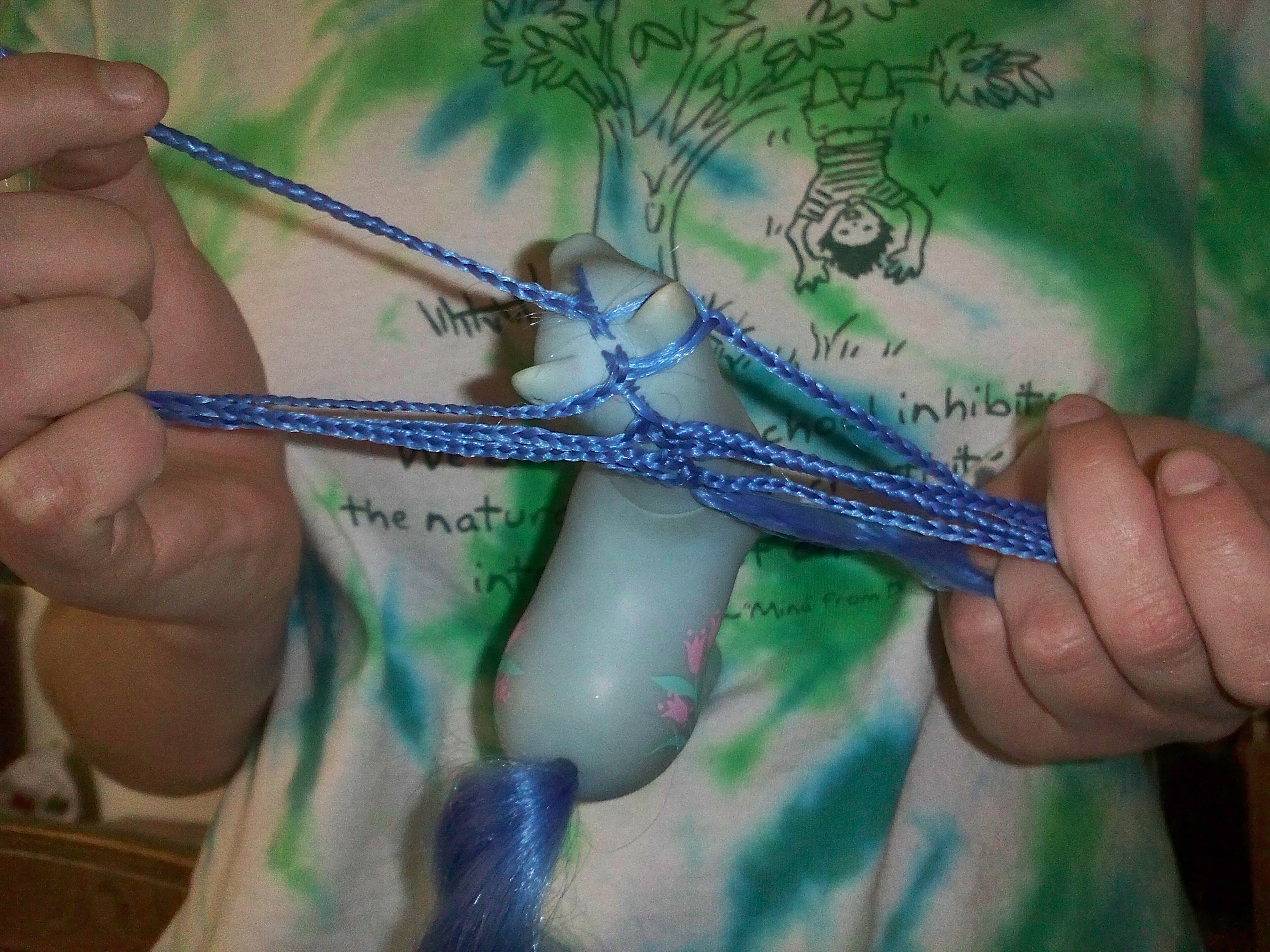
When I started, I took the hair on the Pony's tail and divided it into three pieces for braiding. Soon I became bored with a single braid. I then divided the tail into nine pieces and made three groups. I braided each group of three until I had three braids, then took these three braids and braided them together.

Soon I was up to starting with twenty-seven pieces (nested down to nine braids, then to three and then one) and then on to eighty-one. All the while I was learning about math: I saw that division is the process of taking a large number of things and grouping them into a smaller number of groups. In order to end up with one even braid at the end, I had to be able to divide the initial number evenly by three, then by three, and then by three again, until I ended up with just one braid.
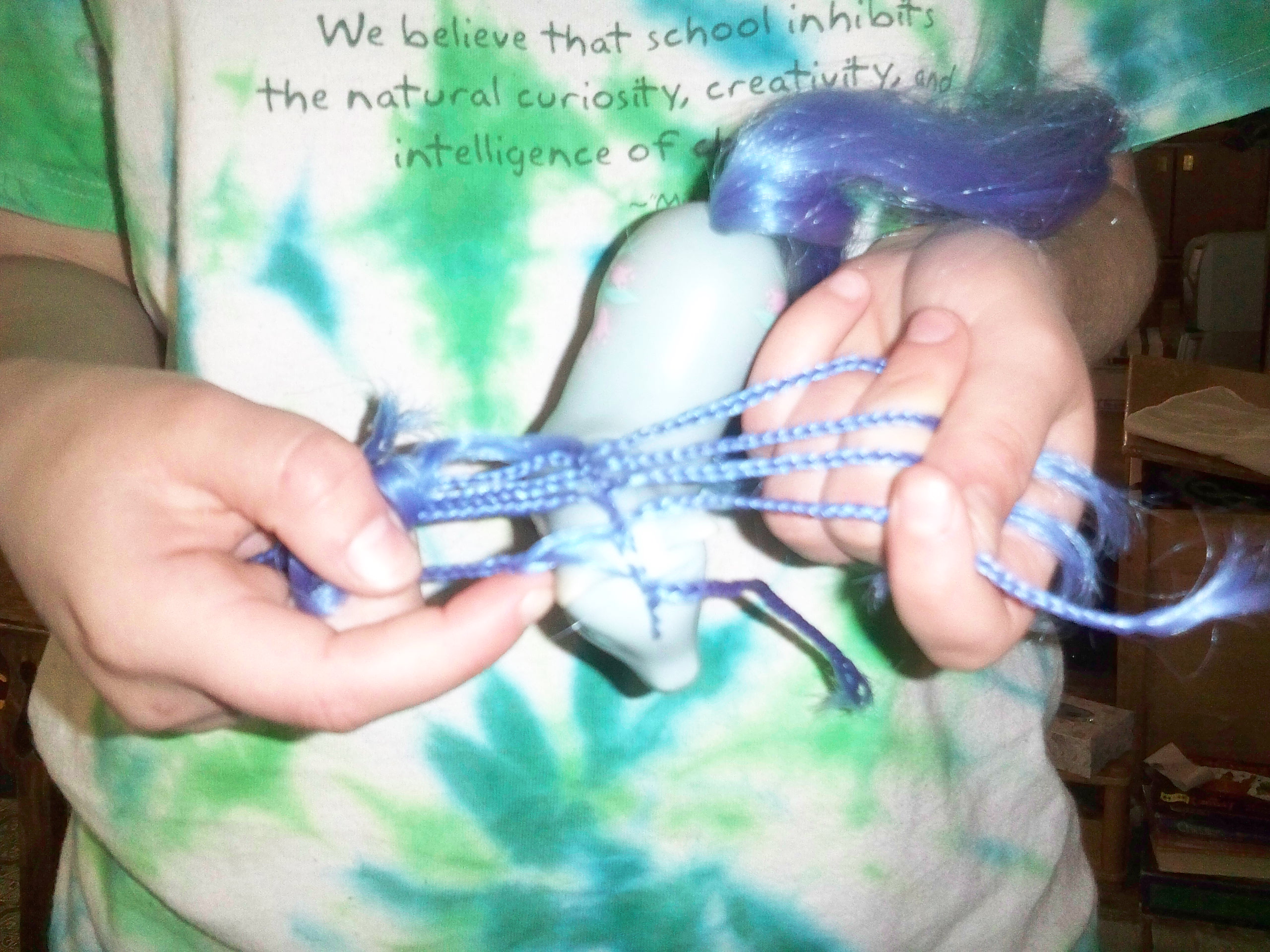
The day after that page was made, I took a photo of some of my daughter's ponies, to use as an illustration at an announcement post, Sleep, Teens, My Little Pony & Science.

Holly, 18, had been away from the house. She came in and saw the ponies out, so I showed her the photo and read her a bit of the Christine Alvarado article. Holly got another pony to show me, told me about the plan of the braids and the angles to get them to cross and stay crossed, and what could be done with those braids, but that she usually twists them into a bun, and had left some unbraided hair out at the bottom of the mane to fasten that bun up with.
I couldn't even keep up with the explanation. Just sayin'... 🙂

There's more of what Christine Alvarado wrote here:
SandraDodd.com/mylittlepony
photos by Sandra Dodd, but Holly did all the braiding

Monday, April 20, 2026

Affirming, accepting, embracing

Amy Childs wrote:

What I do give unschooling complete credit for is that instead of spending Jonathan’s adolescence fighting with him, shaming him, trying to make him do things, judging him, punishing him, or trying to “teach” him anything, instead I spent those years affirming him, accepting him, embracing him, and supporting him in being who he was.

I would never trade those precious years, that once-in-a-lifetime opportunity, nor the relationship that was born between us during those years, for anything in the world.
—Amy Childs

SandraDodd.com/teens/amychilds
photo by Sandra Dodd

Monday, March 9, 2026

Normal reactions

It turns out that much of what is considered "normal teen behavior" is a normal reaction to many years of school, and to being controlled and treated as children and school kids and students rather than as full, thoughtful human beings.


I wrote that, but the source is missing.
I also wrote what's below, and its parent page is linked.


I didn’t know that our relationships could stay so good even when they were teenagers.

My original expectation was that when they were teens they would be frustrated and rebellious and wild, because I thought that was hormonally inevitable.

A side benefit of having been partners rather than adversaries was that the “normal teen behavior” turned out not to have been “natural,” and in contrast to what I was seeing in unschooled teens, it started to look like very sensible reactions to a barrage of arbitrary rules and limitations. The communications and trust continued to build within our family, rather than to erode over the years.

Unexpected Benefits of Unschooling
SandraDodd.com/unexpectedarticle
photo by Sandra Dodd
of Marty, Holly and Kirby
when they were still at home

Thursday, October 30, 2025

Light art (and spooky)

For young children, costumes and decorations can make them feel powerful, or beautiful, and a little afraid—in a fun way, if the adults and older kids help keep that fairly balanced.

I have candy to hand out when the time comes. We have some decorations. I have a lifetime of memories of trick-or-treating when I was little, seeing or being a little way into houses I might never be in again, getting candy and treats from strangers—some of them dressed up, too, and smiling at me.

I have memories of taking my own young children door-to-door, and of driving them to a special place or two beyond walking distance some years.

Young families will be welcome here this year, and older kids and teens, too.

Airy and bright
photo by Janine Davies

Thursday, July 31, 2025

Helping teens

Written when Holly Dodd was 18 (2009), of when she was in her mid-teens:

Holly has had a few jobs. One was working at a skateboard and clothing store in a mall a few miles away. One was working at a flower shop just a few hundred yards away; she walked. But the shop had another shop on the air base, and sometimes she worked there, so she had a base pass and a key to both shops. When Holly's jobs require driving, we let her use a car. Some of her school-attending friends are told they can't get a job unless they buy a car first. It seems to be a way for the parents to say no and then blame the kids for it.

Some mainstream families press their teenaged children to get jobs, and shame them if they fail, while putting conditions on when and where they can work. The result is that getting a job was just one more "do what the parents make you do" situation, and the jobs aren't fun; they're an extension of school and of parental control.

When teens or young adults have chosen to have a job without desperation for money, and when they are accustomed to learning all the time and living joyfully, they are a different sort of employee.

SandraDodd.com/jobs/bigbook
photo by Cathy Koetsier

Saturday, June 14, 2025

Things some people know

Teens who were always unschooled *know* things that other people don't know. My children, for example, know one can learn to read without being taught. They don't think it, kind of believe it, or have a theory about it. They know that it's possible to be honest and trust your parents. They know it's possible for a fourteen year old girl to hang out with her older brothers pleasantly and at their request. They understand why those with unlimited TV in their own rooms can go a long time without turning it on, or why they might want to leave it on to sleep. They have years of experience with the fact that someone with the freedom to choose to stay awake will get sleepy at some point and want to go to bed and sleep. They all understand when it's worth going to sleep even though fun things are going on, and they know how to decide when it's worth setting an alarm to get up.

There are many adults who don't know those things.

All three were teens when I wrote that; they're in their thirties now.

SandraDodd.com/teen/people
photo by Monica Molinar

Friday, March 28, 2025

Fitting dinner into the day

It's not uncommon (historically) for children to eat first, and separately, and food kids like, and then for the adults and teens and guests to eat a little later, at leisure, and not have to worry about whether their food is something the kids would like.

I have more energy in the morning but I don't always want to use it thinking about dinner. When I do, I do better. 🙂 If I start bread and put something out to thaw, or better yet mix up a casserole or put something in the crock pot—at least a sauce or something easy like ground beef or chicken in barbecue sauce—then dinner is easy and if plans change, the thing that was started earlier can go in the fridge.
. . . .

We've never made our kids wait for dinner. If they're hungry, they can snack.
—Sandra, when kids were still home

SandraDodd.com/eating/dinner
photo by Sandra Dodd

Saturday, January 4, 2025

Unschooling is modern, not ancient

Unschooling is a substitute for compulsory schooling, and exists in times and places where nearly unlimited information is available, and "schooling" is compulsory until late teens. Those conditions are not historical. Even in my grandparents' day, people dropped out in elementary school; in my parents' time they could leave school at 15 or 16 years old.

Humans Learn
photo by Sandra Dodd (of local mountains)

Saturday, December 28, 2024

Being available during "school hours"

Responses to concerns posted by nervous parents:


Not having a high school diploma didn't keep my always unschooled daughter out of college, AND she got her first paid job BECAUSE she was unschooled - her dance studio needed someone to cover the afternoon classes of a teacher going on maternity leave, none of the regular teachers were available for that time and the older assistants were in school. She's been employed by them ever since.

It's an interesting twist. 🙂

Deborah in Illinois


Marty has worked "during school hours" since he turned fifteen, and was offered a fulltime job just before turning 17. None of this keeps him from learning, from doing lots of things with other people, nor will it keep him from the option of college. He's working 6:30a.m. to 3:00 M-F. Kinda like school hours, for the first time in his life. 🙂

Sandra in New Mexico

Both those former teens are grown now. Marty's oldest child turns seven today.

SandraDodd.com/teens/
photo by Sandra Dodd

Friday, December 6, 2024

Learning-and-living jobs

Some mainstream families press their teenaged children to get jobs, and shame them if they fail, while putting conditions on when and where they can work. The result is that getting a job was just one more "do what the parents make you do" situation, and the jobs aren't fun; they're an extension of school and of parental control.

When teens or young adults have chosen to have a job without desperation for money, and when they are accustomed to learning all the time and living joyfully, they are a different sort of employee.

SandraDodd.com/jobs/bigbook
gif by Holly Dodd

Friday, July 26, 2024

Philosophy and priority

Questions come up about how a parent can help teens do things they want to do. Here is an example from when I had two teens and one nearly a teen.

It has to do with philosophy and priority. I think the way I discuss whether one of my teens can go to a movie or not under the circumstances of the moment is as true and deep a life-building experience as when he asks me what squares and square roots are about.

2024 note: Truer and deeper than facts that can be discovered anywhere, anytime. Looking back, I see its importance more clearly.

One day we had from seven to seventeen kids here, in various combinations and not all at once. It was a madhouse. Seven was my low count because there are still seven here at the moment. At one point two were gone and were coming back, one was half-expected (and did show up) and Marty wanted to go to the dollar movies to see "School of Rock" with a subset of the day's count. Holly didn't want to go; her guest from England did. Kirby half wanted to go; the girls coming back wanted to see him particularly. So the discussion with Marty involved me helping him review the schedule, the logistics of which and how many cars, did he have cash, could he ask Kirby to stay, could we offer another trip to that theater the next day for those who'd missed it today, etc. I could have said "yes" or "no" without detail, but it was important to me for it to be important to Marty to learn how to make those decisions. Lots of factors.

That's part of my personal style of radical unschooling.

Today: The day this is scheduled to go out, Keith and I will have three grandkids from 8:00 to 1:00, and then the other two at night. There are logistics involved. The oldest grandchild is being paid to come back and help at night. Drivers, food, activities, re-staging between...

Same goals as in the 2003 story above—fun, peace, contentment.

From longer writing, third comment at
SandraDodd.com/unschool/radical
photo by Kim Jew Studios
in those days, but not that day

Sunday, June 16, 2024

Teens can feel crowded

[Teens can feel crowded] by the new and real knowledge that the house is small and the world is huge.

Baby birds have no idea what's outside that nest.

Young children will occasionally find some corner of the house, some closet or a wall surface that was always covered by furniture before and they are not surprised that there are parts of that house they had never seen before. The house is everything.

Teenagers know they are meant to get up and go out. They're not happy about it, sometimes, especially when their house is a haven of love and sweetness and creativity, but their instincts kick in anyway and their perspective changes, very literally, and that nest seems like just a little wad of sticks on one little branch of one of ten thousand trees....

Crowded by their new awarenesses and raging hormones and their relative size (their rooms and beds are getting smaller by the day) and their collections of stuffed animals and action figures and Lego.

Sandra
(January 2000, with one teen and two pre-teens then)

SandraDodd.com/teen/crowded
photo of Holly Dodd on her way to a party


This photo was in the Just Add Light folder for many, many years, waiting for a quote or topic it might slightly match.
Good enough.

Wednesday, April 24, 2024

Sometime I go EEEEEk.


EEEEEk.
What gets me more than the casual acceptance and recommendation of arbitrary limitations is the characterization of allowing children choices as "plonking a 3, 4, 5, 10 year old in front of the television/google."

Can you imagine ANYone "plonking" a ten year old in front of google? And what? Demanding he look something up? But I have seen kids that young have a BLAST with google and other search functions, about games, or YouTube, or NetFlix.

If they can look up game hints at ten, they will be able to look up building codes or disease treatments or various translations of Bible passages on their own anytime thereafter, given resources. Practicing on something that might seem "loose, easy and unnecessary" can *BE* what is needed for them to be competent, functional workers when they're older. And I won't say "when they're grown," because my kids were competent functional workers when they were mid-teens, every single one of them.

So when people who haven't had a child who is mid-teens disparages my knowledge in light of their paranoid theories, sometimes I go EEEEEk.

Sandra
2011

Plonking a child down in front of the television
is where I found it, but the original is here:
on Always Learning,
wherein the rant is all one paragraph.

photo by Sandra Dodd, of a granddaughter playing a game, a husband reading the news, and the TV was playing "Pupstruction" for another grandchild not appearing in that photo

Sunday, September 17, 2023

Priorities, influence, reading

A story from when Kirby was in his late teens:

Kirby was reading aloud the other night from a gaming manual to that big batch of guys who went to see Pirates of Penzance with us. Kirby and Marty really wanted to go to the play. As things turned out, three unexpected others went with us. That was fine. They went because they were involved in a roleplaying game, and wanted to continue it later, and because they trust Kirby and Marty's judgement about what's cool.

They had fun, and came back and played several hours longer afterward. But Kirby, one of the youngest of the seven there, and one of the "least educated," was reading difficult material aloud to attentive others, one of whom... has a college degree, one of whom has two years of college, and none of whom had any reason to say, "Let me read that." He could've been reading it for taping, or radio. Expressive, clear, no hesitation.

He's confident in his skin, in his mind, and in his being.
He's not afraid of his parents.
He goes to sleep happy and he wakes up glad.

My priorities could have been different.


Kirby is in his 30s now, married, and reads each night to two little girls. I wish I could hear it sometimes.

SandraDodd.com/priorities
photo by Sandra Dodd— not of that night's game, but there's Kirby in black to the right, and Marty in green, with other unschoolers

Thursday, September 14, 2023

States of being

Sometimes wind is blowing and sometimes it's still. Usually water is wet, but in some times and places it can be ice.

I have vivid memories of being childless. I had babies, and children, and teens (not all at the same time). Now I'm a grandmother.

May your status and your transitions be peaceful and calm, with joys to discover.

SandraDodd.com/calm
photo by Tessa Onderwater

Thursday, February 2, 2023

Growing up and leaving gently

I have heard many stories of the rearrangements of families with unschoolers who are in their late teens or early twenties, and a young adult will leave, or bring another in, or the house is split up some. The stories are peaceful, and not about fear and arguments.

This, below, is from an interview I did in 2010.
I think when the child leaves naturally and positively, for a good reason, and the parents were willing to have him stay longer, there are fewer regrets and frustrations than under other circumstances. When kids are small, the mom is constantly on call. When Holly was born I had two and five year old boys. I know what it's like to have three young children. I also know what it's like to have three teens driving. But when they're calmly and confidently grown, the mom can leave for a month and they'll still be okay.
—Sandra Dodd

Interview, by Kim Houssenloge, of Feather and Nest
photo by Jihong Tang

Thursday, April 14, 2022

Real world

The thing I think I've seen more than anything else in some of the older unschoolers, the people who are teens who haven't been to school much or at all, is they are so whole. Their place in the world is real. They're not preparing for the possibility of applying to have a place in the world after they're grown. They are in the world. And there's something so different about that.

Unschooling and Real Learning
photo by Sarah Dickinson

Thursday, January 6, 2022

Who reads how

Written when my kids were teens:

Kirby reads like a lawyer. He can skim a rules book or instructions for a game, and explain simply and clearly to others. If he forgets a detail, he'll be able to find it easily.

Marty likes humor and history.

Holly's main reading is on the internet, but she likes name books, and other non-fiction and trivia. One thing she doesn't use the internet for is definitions and spellings. She likes my old full-size American Heritage Dictionary, and will sprint upstairs to look something up on the slightest excuse.

Three Readers—SandraDodd.com/threereaders
(It's all one paragraph in the original.)
photo by Sara McGrath