Thursday, April 23, 2026

Deschooling and Games

Lyle Perry was one of my favorite unschooling-volunteer-helper writers, and the following were his responses to someone who shall remain nameless, who was complaining about Yu-Gi-Oh. The indented sections are Lyle's pull-punches-gently responses. —Sandra


I wonder when he will ever learn anything!
Maybe he's wondering when you will ever SEE what he's learning. Maybe he's wondering when you will join him in what he's learning, or at least express some joy and satisfaction that he IS learning. (He IS learning, you know.)
That's all he talks about. Yu-Gi-Yo Cards
What do you talk about? Anything BUT Yu-Gi-Oh cards? It sounds like you're waiting for him to get through a "phase" or something so he can really get down to some serious learning. The problem is, he's already there, he's just waiting for you to catch up! You're the one that's behind. He's doing the learning, he's moved on, and you're still stuck on the same chapter. It's time to turn the page. Or better yet, put that book down, wrap it in some gasoline soaked newspapers, and offer it up as your last sacrifice to the School Gods. Their powers are obsolete now. Break free from the academic death grip they have on your mind and set yourself free!
And he doesn't know how to play the game, and I am so not interested in trying to teach the game.
Well, that's a pretty depressing attitude. Would you be interested in teaching him geography? Biology? Seismology? Are those the important things? Your things are important and his things are crap? If that's true, I don't blame him for not being interested in your stuff. Why should he get excited about your stuff when you look at his stuff with disdain and revulsion? Don't forget that he's learning something about the signals you're sending him too. He's learning ALL the time. Don't let him learn that his mom thinks what he does is stupid.
—Lyle Perry, the responses
(more here)

SandraDodd.com/focus
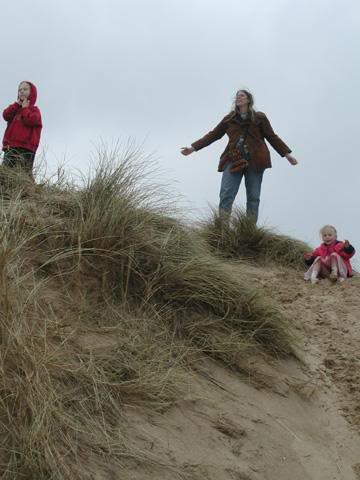
photo by Colleen Prieto

Tuesday, April 21, 2026

Snobbishness vs. Godzilla


Carol/Sognokids wrote, in the middle of something a little longer:

One day Colton and Bud returned from the library, thrilled with what they had found. A video copy of "Godzilla!" I snorted derisively and suggested that our time would be better spent with a book. I was ignored. They made some popcorn and started the movie. I sat with them on the couch, or to be more accurate, on my moral high horse, with an "uplifting" book in hand. I rolled my eyes and sighed with gusto to point out how they were wasting their time. Colton and Bud continued to ignore me.

Something finally penetrated my self-imposed role as the chief of the culture police. A voice whispered in my ear: Look at them, Carol. Just LOOK at them! I studied my son and my husband for about five minutes. They were totally engrossed in the movie, yet they never stopped touching each other. Colton would lean against Bud's shoulder as he giggled helplessly, or Bud would squeeze Colton's leg during a particularly intense moment. They were totally connected to each other through their movie experience, and it was a joy to watch. I knew that they were making a memory together.
—Carol / Sognokids@...

SandraDodd.com/t/godzilla
movie still respectfully borrowed from a website
(this page)

Monday, April 20, 2026

Affirming, accepting, embracing

Amy Childs wrote:

What I do give unschooling complete credit for is that instead of spending Jonathan’s adolescence fighting with him, shaming him, trying to make him do things, judging him, punishing him, or trying to “teach” him anything, instead I spent those years affirming him, accepting him, embracing him, and supporting him in being who he was.

I would never trade those precious years, that once-in-a-lifetime opportunity, nor the relationship that was born between us during those years, for anything in the world.
—Amy Childs

SandraDodd.com/teens/amychilds
photo by Sandra Dodd

Sunday, April 19, 2026

Your own certain knowledge

Vague interest can turn to trust in others' accounts of learning and of parenting successes. Trust in those stories can give us courage to experiment, and from that we can discover our own proofs and truths to share with newer unschoolers, who might find courage from that to try these things themselves. Faith in others can only take us a little way, though, and then our own children's learning will carry us onward.
Some ideas become theories. A few theories might turn to convictions. Some early thoughts will be abandoned; others will gain substance. After much thought and use, what is left will be what you believe because you have lived it.

SandraDodd.com/knowledge
photo by Cátia Maciel

Saturday, April 18, 2026

Simple and very difficult

Pam Sorooshian wrote:

An unschooling parent needs to be fully present with their kids, sensitive to their kids' needs, and extremely respectful of their kids' interests. This is simple and very difficult, at the same time. It is so simple, it really asks so little of us, as parents, to pay attention to what "is" right in front of us. But it is very very difficult to do, sometimes, especially when what our kids are presenting to us appears to us to be negative or dull or unproductive.
—Pam Sorooshian
(more, with examples)

SandraDodd.com/being
photo by Jihong Tang

Friday, April 17, 2026

Making one move

When Kirby and Marty were little, and playing with toys, Marty said "Pause it!" when he needed to leave for a moment, but wanted Kirby to wait for him. He was used to watching video tapes, and playing Nintendo.

The concept of a time-out lives more largely in younger people than in some of their parents. It's GOOD to wait a moment, to stop, to await others' input.

Human interactions should be like games, sometimes—after I "move," I can wait while the other person makes a move, a comment, a response. Then it might be my turn again.

SandraDodd.com/decisions
photo by Cátia Maciel

Thursday, April 16, 2026

Crazy-large vocabulary

Some languages are simpler than English in that the letters and sounds match pretty consistently. French and Spanish come to mind. German. But because of something that happened in 1066, and because of the history of The British Isles, and because of the isolation of some English speakers and the migration of many others, English has complexities and a crazy-large vocabulary. Our basic grammar and language are Germanic. The majority of our vocabulary is from French (look up 1066 if you don't remember what happened) and Latin, though the everyday words we use are from Anglo Saxon, which had borrowings from half a dozen Germanic dialects.

If that was a painful paragraph to read, never mind it. If that paragraph was fun for you, then you can help your children spell by looking up what language a word is from and figuring out why it looks the way it does in written English.

SandraDodd.com/phonics
(Phonics, thoughts, trivia)
photo by Roya Dedeaux