Showing posts sorted by relevance for query /words/words. Sort by date Show all posts

Monday, May 11, 2026

More careful than "authentic"

Once upon a time in 2007, I was responding to a mom who was being dismissive (of her children) and defensive (of the discussion):

She:

I think that because of the tool we are using here to communicate that something is lost in translation.

I:

Don't try to use a saw as a hammer.

The tool we're using here can be used very well, but it takes thought and practice. No one is preventing reflection and proofreading. It's fine (and would be good) for you to hold a post and edit it carefully. Those who choose not to shouldn't complain about reactions.


She:

As powerful as words can be, the right attitude and heart behind the mistake can change how the words were perceived.

I:

Words can harm children forever. You're very unlikely to traumatize any of the moms reading here, but we can help you learn not to traumatize your children, and to think and write more clearly, if you want.


She:

Sandra also said, "Watch your thoughts, because without doing that you can't really learn to choose better reactions."
I agree with this in part.

I:

IN PART?


SandraDodd.com/authentic
photo by Rosie Moon

Friday, April 26, 2019

History, in a word

A parent cannot decipher words for a child. Only the child can decipher written language. You can help! You can help LOTS of ways. One way would be to gain an interest in the words you use yourself, and stop once in a while to examine one, its history, why it means what it means.


Here are some fun practice words you can probably figure out without looking them up, maybe.
Cambridge
breakfast
trailer
another
never

SandraDodd.com/etymology
These days, you might be able to ask Siri or Alexa for the etymology of a word.
photo by Sandra Dodd

Wednesday, June 12, 2024

Fairness, in arguments

Sandra Dodd, from 2012 [so add some years to the number]:

Twenty-five years ago, my husband said it wasn't fair that we were culturally limited to words, and I could always win with words. If physical ability "counted" he would win, so he was set up to lose. After that I tried not to "beat him up" with words, because he was right—it wasn't fair. When friends of ours got married, and the husband was strong, fast AND very much more verbal, I told him that story, and he appreciated it. He reported back a couple of times early in their marriage that he was about to totally, easily win an argument, and remembered that it wasn't fair, and backed down.

AlwaysLearning; Alex P. quoted me, and commented
photo by Cally Brown

Thursday, April 18, 2019

Use your words

Someone once wrote:
"In the past my kids have tended to expect to be waited on hand and foot."

I responded:
If you use phrases like "to be waited on hand and foot," you're quoting other people. That usually means the other person's voice is in your head, shaming you. Or it means you've adopted some anti-kid attitudes without really examining them. If you're having a feeling, translate it into your own words. It's a little freaky how people can channel their parents and grandparents by going on automatic and letting those archaic phrases flow through us. Anything you haven't personally examined in the light of your current beliefs shouldn't be uttered, in my opinion. Anything I can't say in my own words hasn't really been internalized by me. As long as I'm simply quoting others, I can bypass conscious, careful thought.

SandraDodd.com/phrases
photo by Sandra Dodd

Sunday, March 4, 2012

A better environment for learning


(About online discussions of unschooling:)

Pointing out the words people use is never a waste of time.

Showing people that they have expressed their thoughts in writing in words of their own choosing and posted them is often THE BEST, the most effective way, of moving them from the plateau of *thinking* they get it, because they can recite back the answers, and really, truly, honestly getting it in a way that creates a better environment for learning and being.

Mindful of Words
photo by Sandra Dodd

Tuesday, August 16, 2016

Softer words

Some parents express their learning as "struggle" or "challenge," but those words are antagonistic. Try to relax, and try not to feel that you're wrestling (with your child's desires, or with your own thoughts).

If you can find softer words, you will experience softer emotions.


SandraDodd.com/battle
photo by Sandra Dodd, of a flowering plant
growing out of a rain spout
on a castle

Tuesday, March 3, 2026

That was all!?

AJ wrote:

I'm amazed at how easily some things are learned. My five year old is learning to read. He was playing a computer game that had him putting together words to make compound words (sand + box gives you sandbox, etc.). He wasn't sure of a word, so I told him what it was and explained about how words ending in "e" work. Pointed out one or two more examples as they came out and presto! He understands Silent E.

Then I stood there not sure what to do. That's it? That was all it took to learn about Silent E?? But, but...it was a huge deal when I learned to read in school! There were many lessons. Drills. That song on the Electric Company. How could all of that fuss have been needed for something that took Mikey about 30 seconds to grasp? Ah, the wonders of learning something when you are ready and not before!
—aj (mamaaj2000)

SandraDodd.com/learning

"that song on the Electric Company"
photo by Karen James

Sunday, September 8, 2024

Lessons and pressure won't help.

Each person who learns to read learns almost suddenly, at some point. It happens whether he's in school or not. Before that point, the words are scribbles. After that point, he sees a word and knows what it means, without sounding it out, without looking it up. The scribbles turn to words.
. . . .

Before a child can read, He Cannot Read. Lessons and pressure won't help. It's not making sense yet. One day the marks become words, IF he has not been pressured and shamed, rushed and blamed.

Some Thoughts About Later Reading
photo by Andrea Quenneville

Tuesday, August 13, 2013

Words

signs at an old shop

Please be careful with words, because they say what you're thinking. Be careful with thoughts because they affect the way you're responding to people.

SandraDodd.com/words
photo by Sandra Dodd

Friday, June 26, 2026

One seamless whole

Tina Bragdon wrote:

More and more I am beginning to understand what you say about the power of our words, the semantics of them, and what they reveal about our thoughts deep down. I used to think long ago this was a bit nitpicky, but really can see what you mean when I really stop and think about it.

I think that awareness (for me anyway) is easier to come by with some of our loaded words like "lazy", "she-he always/never.." and such, but most of us weren't homeschooled let alone unschooled and as such don't realize the impact of being graded, sorted, and categorized from the age of 2-3 or so (ie-being regarded as "toddler", preschooler" and so on).

The more I take the word "teach" out of my vocabulary and am conscious of it the better it is for me and the easier it is to see my children's lives as one seamless whole and not divided by subjects.
—Tina Bragdon

The School in my Head

Mindful of Words

SandraDodd.com/subjects
photo by Holly Dodd

Monday, April 30, 2012

Use your words

Someone once wrote:
"In the past my kids have tended to expect to be waited on hand and foot."

I responded:
If you use phrases like "to be waited on hand and foot," you're quoting other people. That usually means the other person's voice is in your head, shaming you. Or it means you've adopted some anti-kid attitudes without really examining them. If you're having a feeling, translate it into your own words. It's a little freaky how people can channel their parents and grandparents by going on automatic and letting those archaic phrases flow through us. Anything you haven't personally examined in the light of your current beliefs shouldn't be uttered, in my opinion. Anything I can't say in my own words hasn't really been internalized by me. As long as I'm simply quoting others, I can bypass conscious, careful thought.

SandraDodd.com/phrases
photo by Sandra Dodd

Monday, April 27, 2020

The whole language

Because phonics treats written English as a simple code when it is not, many children are frustrated very early on.

Whole language involves language as communication, rather than separate parts (writing/reading/spelling). First language; details later.

With unschooling, children will learn from the language you use and they use, from the words they see around them, from using games and computers, from signing greeting cards or playing with words. There's no need for any school-style structure at all. For those who have worried about phonics and reading and spelling, please don't press that on your children.


Play with words
photo by Caroline Lieber

Wednesday, June 27, 2012

Magical music


Words are just words, on the one hand, and they are our connection to the divine, on the other. And the divine is often depicted with more than two hands (even Jesus has the nail-pierced hands, and his other hands, though not on the same statue like Ganesha might have), so on another hand words are magical music. And on another hand they are our link to the past and our messages to the future.

SandraDodd.com/wordswords
photo by Sandra Dodd, of a little bird feeder,
or something, in Yvoire, France

Monday, December 8, 2025

Clarity of thought

For clarity of thought and for value of discussions about unschooling (or anything), it's important to use words intentionally and carefully. If a parent can't tell the difference between "consequences" and "punishment" and doesn't want to even try to, she'll probably keep punishing her children and telling herself it's not punishment, it's consequences. That muddled thinking can't lead to clarity nor to better parenting.

Untangling confusion with words often takes the use of other words, which is why people whose primary interests don't involve language can become very frustrated with others who say "But 'principle' is NOT just another word for 'rule'."

SandraDodd.com/semantics
photo by Tara Joe Farrell

Saturday, February 7, 2015

Books and clocks. . . music, blocks


Meredith Novak wrote:

If you live in a home with books and clocks, movies, music, blocks, games, dishes, furniture, toys, clothes, the internet, and adults who are interested in kids, then you have "the basics" all around your kids all the time. And because those basics are there, kids will learn about them—they'll learn that words are a valuable tool and there are many ways to use them. They'll learn that numbers and patterns are as useful as words and sometimes better than words for a given purpose. They'll learn those things without lessons, living and playing and snuggling on the couch with you without ever needing to draw a line between those things and learning.
—Meredith Novak
SandraDodd.com/meredithnovak
photo by Sandra Dodd

Thursday, August 29, 2019

Words and thoughts


Words and thoughts are what you will use to change your beliefs and behaviors.

Mindful of Words

Monday, April 4, 2011

Other sources of information


I'm happy to know I'm not the sole source of information for my kids.

Last night I came to use my computer and there was a dialog on the desktop, a leftover instant message between my thirteen-year-old son Marty and an older homeschooler. This was the entirety of that dialog:

Marty: You coming down?
Other kid: yeah.
Marty: Did you know Canada has Prime Ministers?
Other kid: yeah
Marty: dude

Now I will never have to explain to Marty that Canada has a prime minister. I don't know why he cared, on a Friday night in New Mexico, but it doesn't matter.

SandraDodd.com/words/words
For the record, "last night" was in late 2002, and the other kid was Brett Henry, also unschooled, who is now a firefighter in the Los Alamos Fire Department.

photo by Sandra Dodd

Thursday, September 8, 2016

Canada... dude!


I'm happy to know I'm not the sole source of information for my kids.

Last night I came to use my computer and there was a dialog on the desktop, a leftover instant message between my thirteen-year-old son Marty and an older homeschooler. This was the entirety of that dialog:

Marty: You coming down?
Other kid: yeah.
Marty: Did you know Canada has Prime Ministers?
Other kid: yeah
Marty: dude

Now I will never have to explain to Marty that Canada has a prime minister. I don't know why he cared, on a Friday night in New Mexico, but it doesn't matter.

SandraDodd.com/words/words
For the record, "last night" was in late 2002, and the other kid was Brett Henry, also unschooled, who is now a firefighter in the Los Alamos Fire Department.

photo by Sandra Dodd

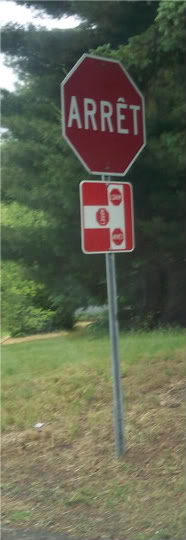
P.S. Since writing this, since taking that photo, I went to France and discovered that their stop signs say "Stop." Why, I asked my French host-mom, do they say "Arrêt" in Quebec? She said Quebec wants to be more French than France. One more bit of information that won't be on the test. Trivia.

Tuesday, March 24, 2020

Keys to knowledge

One of a child's best tools is to learn to ask "What's that?" It's one of a baby's keys to knowledge. "Sa-sat?" said one of my kids. Hundreds of times, pointing. "Sa-sat?" Another said, "Aht-dat?"

With names for things, categories form. Some small furry animals ARE "dog" and others are not. "Not" needs another name.

On naming, a researcher named J. Doug McGlothlin wrote, "A child possesses a natural desire to call an object by its name, and he uses that natural desire to help him learn the language. He receives real joy from just pointing out something and calling it by name. He never thinks it is stupid or silly to say something that others might consider obvious. For him, it is delightful."

SandraDodd.com/words/words
photo by Cass Kotrba

Friday, August 19, 2022

Ukulele window

There is something you already have that can be fun and soothing: words. "Ukulele window" has a pretty rhythm, and is fun and easy to speak. Feel all the positions in your mouth, and think of other windows, other places, with a ukulele, or two or ten. This photo was taken in England, somewhere.

The colors are pretty. Someone decided in which order they should be arranged, while the display was set up. Most are probably off in homes—all sorts of places, with all kinds of people.

No one gets to know, but anyone can consider and imagine the possibilities.

Ukulele was originally a Hawaiian word. Window was lifted from Norse, but that's where words come from—all over the place.

The more you know, the better ukulele windows will be.


SandraDodd.com/curiosity
photo by Julie D